Applied recoverability stack
Protein folding, fractal TSP, and live critical path — Python labs built on the same retained-coherence physics. Restricted empirical. Unification still open.
Applied · Applied · Restricted · 2026-09-07 · compiled 2026-10-10 · 7 min read · 5 claims · 5 X sources
Original on X · Package: WetLabEngine (root) · JSON · Cite
applied · protein · TSP · critical-path · python
On this page
- The three labs
- Protein folding — Villin HP35
- TSP — not a shorter tour
- Critical path — a plan already in motion
- C3++ — the LLM instrument of the same family
- What they unify under — still a question
- Where to run it
Causal stack
- 00 Astra / global consistency
- 01 Genesis Pin
- 02 Retained pruning-order history
- 03 Admissible slice
- 04 L1 (closed)
- 05 L2 (closed)
- 06 L3 hyperedge memory T_H + D_L3
- 07 L4 H₄ rank lift
- 08 Discrete atlas / scalar accessibility
- 09 GEM-bridge / gravity
These three labs are not a side project. They are the same recoverability stack transferred into runnable Python: a protein audit on WetLabEngine, a fractal traveling-salesman backbone, and a live critical-path optimizer. C3++ is the LLM-side instrument of the same family. The physics is retained information — visible state G_t plus hidden retained history R_t — not a fitted TSP heuristic and not a folding oracle.
One operator, three labs
Preserve what remains coherent. Deform what is stressed. Reset only what became stale. Posted as recurrence across domains that should not casually rhyme. The 10 May question — what equation unifies them — is still open.
Restricted
On the posted cases, the same remember-what-survived pattern was transferred into protein, TSP, and live critical-path Python. That is an applied recoverability claim. It is not a proof that those domains share a law, and it is not gravity.
The three labs
| Lab | Posted | What is claimed | What is not |
|---|---|---|---|
| Protein — Villin HP35 | 14 Apr 2026 | R_t lifts AUC on controlled cases; same visible conformation can still diverge | AlphaFold refuted; a folding oracle |
| Protein — frozen v9 (1UAO / 1L2Y) | 12 Apr 2026 | Backbone / angle ordering; RMSD directional; author 7.6/10 | Full folding; long-range contact closure; TOE proof |
| Protein — Labs/p53 | Aug 2025, GitHub-only | R248Q electrostatic vs Y220C kinetic trap among misfolded globules | Native p53 folding; a cancer therapy |
| Protein — Labs/MECP2 | Aug 2025, GitHub-only | InterfaceAnneal seats R106W / R133C; Run 5 is a DEVIATION | A Rett therapy; 19/19 clean |
| TSP — coherence backbone | 11 Apr 2026 | Different objective: smoother information-bearing tour, not a shorter one | A championship TSP solver |
| Critical path — live plan | 1 May 2026 | Preserve / deform / reset on a plan already in motion | A unification theorem; a Gantt replacement product |
Restricted empirical on the posted harnesses. Recurrence is not a closed law.
Protein folding — Villin HP35
WetLabEngine is a white-box protein-simulation audit engine sitting at the GitHub root: a JSON science contract, deterministic checks, an AI peer-review pass. Run Labs/MECP2 first (15 CONFIRMED / 1 DEVIATION / 3 INDETERMINATE; recipe on the protein-audit page). On 14 Apr 2026 Aaron posted the Villin HP35 result from that pipeline. Two chains with identical visible conformation can still have different folding fates because of hidden retained history R_t. G_t-only models miss it. The author tagged the claim speculative the same day. Two days earlier he posted the frozen v9 bridge on 1UAO and 1L2Y — backbone-ordering, not full folding. Separate GitHub-only campaigns from Aug 2025 (Labs/p53, Labs/MECP2) use the same audit engine on disease mutants; they were never load-bearing X field notes in this compile.
The ROC lift (AUC G_t + R_t ≈ 0.9569 vs G_t alone) shows real predictive signal from R_t. The matched-state divergence (50.2 % far-R_t vs 1.3 % close-R_t, +48.9 % spread) directly falsifies pure visible-state completeness.
Restricted
On the posted Villin HP35 controlled cases, adding retained state R_t lifts AUC and opens a matched-pair divergence gap versus G_t-only. This is not a claim that AlphaFold is refuted, and it is not a folding oracle.
TSP — not a shorter tour
The traveling-salesman transfer is the cleanest statement of the stack’s objective. On 11 Apr 2026 Aaron posted a 100-point 3D cloud run against nearest-neighbor. Nearest-neighbor was shorter and more jagged. The UQCF-GEM ensemble was longer and smoother — a backbone, not a length champion. A 31 Mar origin-story reply also named a fractal TSP run (10k cities vs nearest-neighbor on x86). That 10k transfer is origin-story, not a published residual. The 100-point comparison is the numbered result.
- Nearest neighbor — length 1984.6, coherence 0.2267.
- UQCF-GEM best-of-20 — length 2492.7, coherence 0.5251, best seed 4.
- Posted read: nearest neighbor minimizes local distance; UQCF-GEM propagates by preserving local directional coherence under fractal scaling.
Same 3D point cloud, different objective. Nearest neighbor minimizes local distance. UQCF-GEM propagates by preserving local directional coherence under fractal scaling. The result is not a shorter tour, but a smoother, information-bearing backbone.
Absolutely agree — NN locks in a shorter, jagged tour by greedy local distance (coherence 0.2267), but UQCF-GEM's fractal coherence propagation yields a smoother, backbone-like path (0.5251) even if longer. It's not TSP optimization; it's emergent structure from local rules + scale invariance.
Restricted
On the posted 100-point 3D cloud, the UQCF-GEM ensemble is a longer, higher-coherence backbone than nearest-neighbor. That is a different objective, not a TSP solver championship, and not a protein-backbone derivation.
Critical path — a plan already in motion
On 1 May 2026 the same pattern was posted as a live Python critical-path optimizer. Not a static Gantt chart. A plan already in motion, with real commitments locked in. When reality changes, most systems either throw the whole plan away or bolt a patch onto too much of the old one. Both fail. The posted operator: preserve what remains coherent, deform what is stressed, reset only what became stale. The post lists quantum, fractal growth, Villin HP35, and Great Grok Challenge holdouts as rhyming domains and says it is not a proof.
The best next plan is not always the shortest new plan. It is the one that improves the future without destroying the valid past.
I’m not saying this proves anything but I am saying the recurrence is getting impossible to ignore. Survival doesn’t always restart from zero. It often optimizes by remembering what endured — and pruning the rest.
Restricted
The 1 May live critical-path post is an applied transfer of the remember-what-survived operator into a plan already in motion. It is not a unification proof and not a product claim.
C3++ — the LLM instrument of the same family
C3++ is not a fourth lab in the 10 May question. It is the telemetry built to watch the same process in an LLM: Strain, Drag, Turn Reliability on a Qwen3-4B run (25 Mar) and a five-model forensic (27 Mar). Pink-noise / spectral health is the named retained channel the governor reads (30 Mar hypothesis; GitHub mem_pink_noise_deviation). A 31 Mar origin-story reply is explicit: the project tried to falsify a shared attractor, transferred the pattern into TSP and simple protein folds, and built C3++ as the AI-side instrument. Restricted observability. Not a hallucination solver. Battery recoverability (V720–V724) is a sibling applied assay on NASA PCoE data — same recoverability idea, different domain.
What they unify under — still a question
On 10 May 2026 Aaron asked Grok what equation sits under the protein, RCLC, critical-path, and TSP simulations, what the work is for on top of the physics, and what it all unifies under. Same-day: the work stays on X and GitHub; others are free to use it. A 2 May follow-up used stronger language — one operator, one fixed χ ≈ 0.2667, every scale, data will decide. This atlas keeps the 10 May ask as the honest line. χ ≈ 0.2667 is the April quadratic-RG γ, later frozen at 0.2613 = 3 − 2.7387 in other packets. Reusing it as a universal applied-lab constant is not a 2026 supported result.
Please explain the equation and work that underlines all of my simulations (proteins, RCLC, critical path, TSP, ect). What am I doing that work for on top of the other physics work and what does it all unify under?
Open
Whether protein, TSP, critical path, and C3++ share one operator — and whether that operator is the quadratic-RG χ — remains an open question. Recurrence across posted Python labs is not a closed unification law.
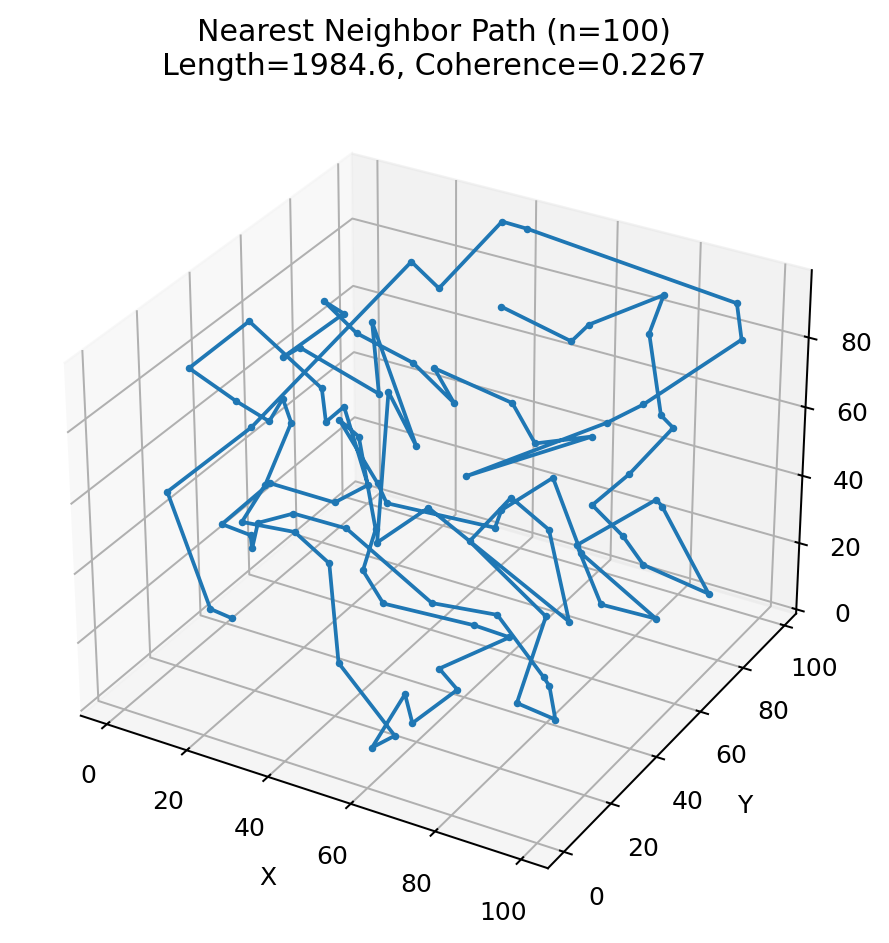
Restricted
Posted read of the TSP transfer: nearest neighbor is the short jagged tour; UQCF-GEM is the longer information-bearing backbone. Restricted empirical on the posted 100-point cloud. Not a championship solver.
applied_recoverability_operator.py (pedagogical reconstruction)
def recover(G, R, shock, tau_lo=0.25, tau_hi=0.72):
    stress = strain(G, R, shock)
    keep   = G[stress < tau_lo]           # preserve
    warp   = deform(G[(stress >= tau_lo) & (stress < tau_hi)], R)
    reseed = reset(G[stress >= tau_hi])   # only the stale
    return splice(keep, warp, reseed)
Where to run it
Protein audit lives at the WetLabEngine root. C3++ flight logs and the critical-path video live on X. The 100-point TSP comparison is an X result with posted numbers; a Tmp/TOE folder was not required for it to exist. Proofs & simulations remains the front door for the geometry harnesses (atlas, compatibility lab, SPARC). This page is the front door for the applied transfers of the same physics. The live labs reconstruct the operator in the browser — teaching toys, not the posted residuals.
- Live labs — protein · TSP · critical path
- Villin HP35 R_t audit
- p53 campaign
- MECP2 Rett campaign
- Frozen v9 1UAO / 1L2Y
- TSP coherence backbone
- New Critical Path
- C3++ Stability Governor
- Battery recoverability
- Proofs & simulations
- 100-point TSP backbone (11 Apr)
- Live critical path (1 May)
- What unifies them (10 May)
- WetLabEngine (GitHub root)
X sources
Original posts this article was compiled from. The notebook copy is editorial; the status URL is the source.
-
2026-04-14
Villin HP35: identical snapshot, different fate
-
2026-04-11
TSP coherence backbone vs nearest-neighbor
-
2026-05-01
Retained coherence in live critical path
-
2026-05-10
What unifies proteins, RCLC, critical path, TSP
-
2026-03-25
C3++ Stability Governor on Qwen3-4B
Previous The Great Grok ChallengeNext Protein program closeout
Causal stack
- 00 Astra / global consistency
- 01 Genesis Pin
- 02 Retained pruning-order history
- 03 Admissible slice
- 04 L1 (closed)
- 05 L2 (closed)
- 06 L3 hyperedge memory T_H + D_L3
- 07 L4 H₄ rank lift
- 08 Discrete atlas / scalar accessibility
- 09 GEM-bridge / gravity
On this page
- The three labs
- Protein folding — Villin HP35
- TSP — not a shorter tour
- Critical path — a plan already in motion
- C3++ — the LLM instrument of the same family
- What they unify under — still a question
- Where to run it
Related articles
- Start here
- Falsification and next step
- Claim ledger
- Recoverability geometry
- TSP coherence backbone
- New Critical Path
- C3++ Stability Governor
- WetLabEngine protein audit
- p53 mutational mechanisms
- MECP2 Rett MBD–DNA campaign
- Frozen v9 protein bridge (1UAO / 1L2Y)
- Battery recoverability (V720–V724)
- Proofs, simulations, and figures
- X science notebook
GitHub packages
Field notes
-
Villin HP35: identical snapshot, different fate
2026-04-14
-
TSP coherence backbone vs nearest-neighbor
2026-04-11
-
Retained coherence in live critical path
2026-05-01
-
What unifies proteins, RCLC, critical path, TSP
2026-05-10
-
C3++ Stability Governor on Qwen3-4B
2026-03-25