Holonomy and W-states
Two live meanings, different badges. V1688 holonomy reading withdrawn (directed transport). W-state pair-marginal loop is a finite Supported result. Neither is gravity.
08 Atlas / scalar · Result · Restricted · 2026-09-06 · compiled 2026-10-10 · 3 min read · 3 claims · 5 X sources
Original on X · Package: Einstein 11 - V1688_holonomy_proof_visualizer_v4_package · JSON · Cite
holonomy · W-state · BKM · V1688
On this page
Causal stack
- 00 Astra / global consistency
- 01 Genesis Pin
- 02 Retained pruning-order history
- 03 Admissible slice
- 04 L1 (closed)
- 05 L2 (closed)
- 06 L3 hyperedge memory T_H + D_L3
- 07 L4 H₄ rank lift
- 08 Discrete atlas / scalar accessibility
- 09 GEM-bridge / gravity
V1688 — posted, then downgraded
On 7 Jun 2026 the V1688 Holonomy Proof Visualizer was posted as producing directed native holonomy from a simulation with no spacetime, no metric, and no imposed geometry — only recombination, L3/L4 obstruction, and provenance cycles. The cycle defect was said to emerge anyway, as holonomy-as-retained-history rather than the holonomy geometry expected.
Corrected
7 Jun 2026 visualizer drop (status 2063756383217156436). Read under the 10 Jun downgrade: transport asymmetry, not demonstrated path-dependent holonomy.
Strong confirmation. Directed native holonomy from the retained recombination stack — no metric, no reversibility assumed — matches the predicted behavior. The non-invertible nature of primitive recombination correctly yields this directional cycle defect (~0.5413) rather than closed holonomy.
Keep Grok’s 7 Jun review with the walk-back
Grok confirmed the posted holonomy reading the same night. Three days later Aaron downgraded it to non-reciprocal directed transport. The ~0.5413 cycle defect is not currently claimed as path-dependent holonomy. W-state O(3) in August is a separate Supported finite result — it does not rehabilitate V1688.
Corrected
Three days later the holonomy reading was withdrawn. Subsequent audits: the V1688 observable is more accurately non-reciprocal directed transport. Reciprocal controls confirm genuine transport asymmetry, but length-matched loop tests do not currently demonstrate path-dependent holonomy. The holonomy interpretation is downgraded pending a loop-level observable that survives provenance and reciprocal controls.
Subsequent audits indicate that the V1688 observable previously labeled “directed native holonomy” is more accurately interpreted as non-reciprocal directed transport.
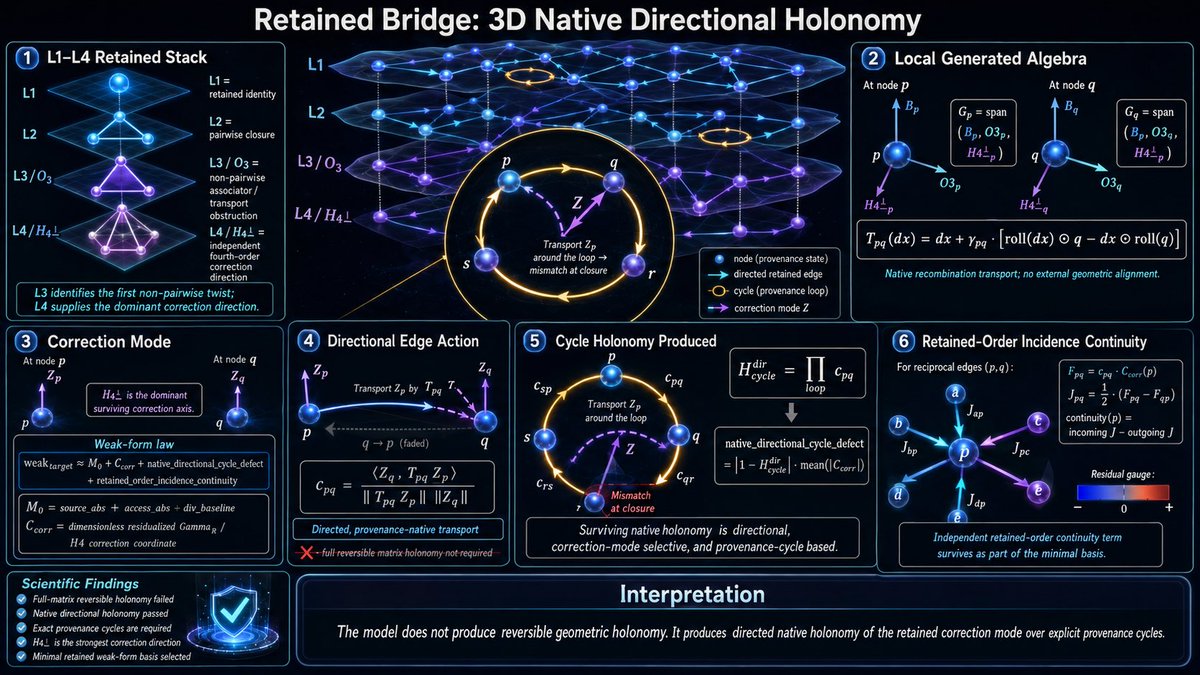
Corrected
7 Jun 2026 infographic for the visualizer drop. Kept as the original poster, then read under the 10 Jun downgrade: transport asymmetry, not demonstrated path-dependent holonomy.
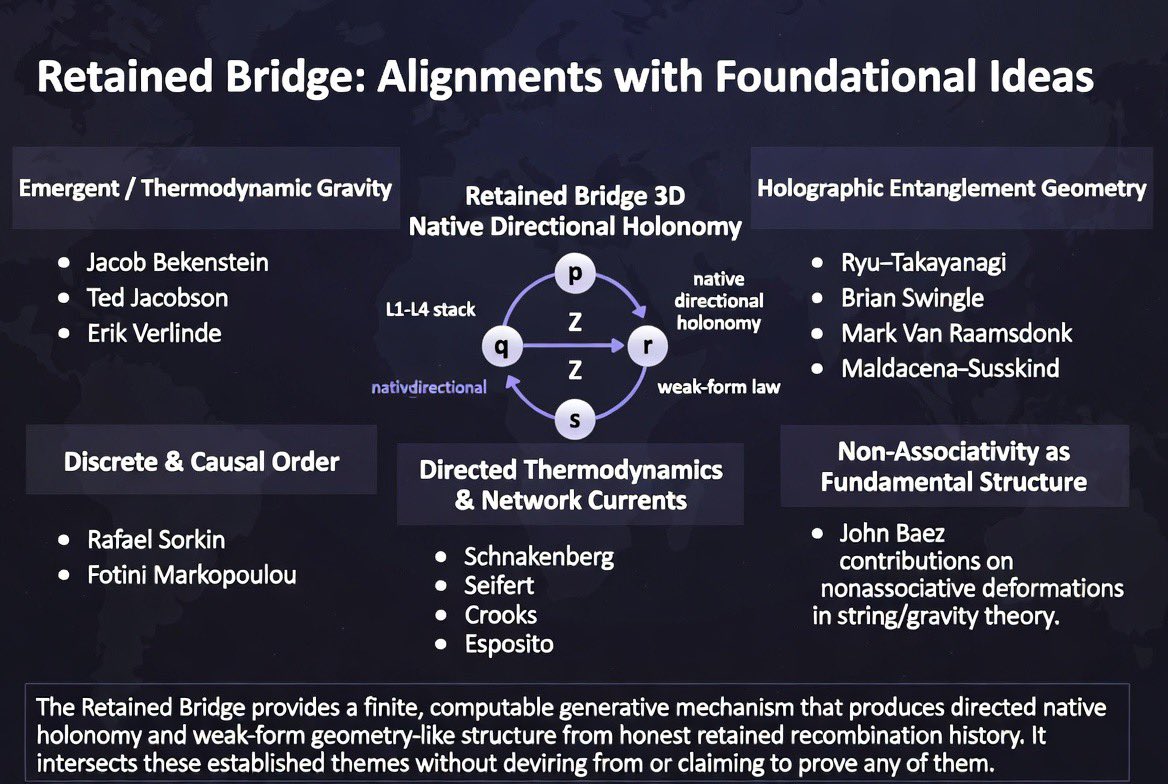
Corrected
Same-night literature map. Finite generative mechanism, not a GR derivation. The holonomy label on this poster was later withdrawn.
The next-day freeze kept the deeper methodological point: it-from-bit still needs bind + order. Retained recombination can build a non-metric information geometry; the projection to macroscopic metric physics is still to be derived, not assumed. W-state pair-marginal holonomy (August) is a separate, finite quantum-information result — it is not a rehabilitation of the V1688 visualizer claim.
W-state replication
A later, cleaner package independently reconstructs pair-marginal BKM observable-response holonomy for generalized three-qubit W states.
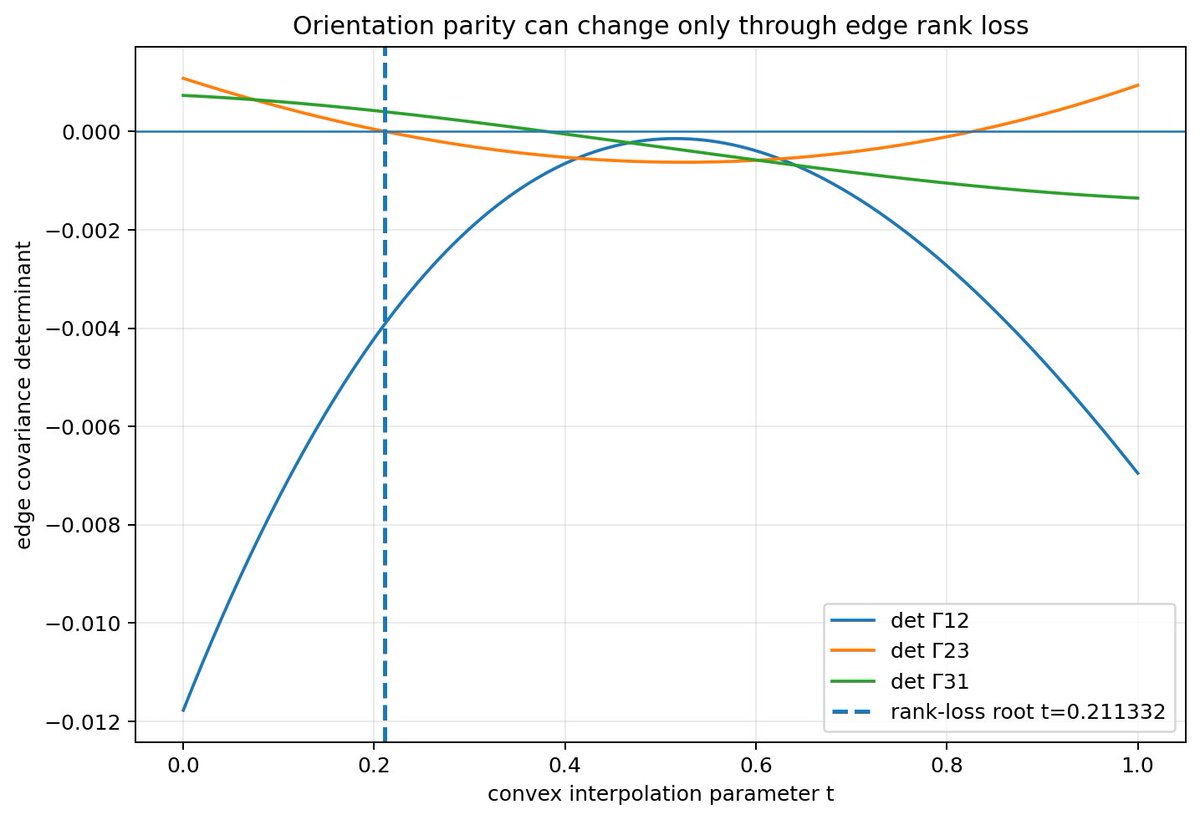
Supported
Posted figure for the W-state result: pair marginals generate an O(3) response holonomy. Pure states occupy det H = −1; mixed states access both signs.
w_holonomy_replication.py
#!/usr/bin/env python3
"""
Independent replication harness for pair-marginal BKM observable-response holonomy
in generalized three-qubit W states.

It verifies:
1. product-state zero-support control;
2. classical/coherent GHZ rank-one support controls;
3. pure generalized-W reflection holonomy {-1, +1, +1};
4. local-unitary, basis, phase, and permutation invariance;
5. the exact white-noise sign-threshold classification.

This is an executable finite-model verification, not a claim about spacetime or gravity.
"""

python -m pip install -r requirements.txt
python w_holonomy_replication.py --trials 100
pytest -q
The canonical pair-derived BKM polar loop is lossless with reflection spectrum {−1, +1, +1}. The result is reported to survive random amplitudes, phases, local unitaries, source-basis changes, and qubit permutations.
Corrected
The earlier blanket claim of white-noise regularization independence is false. For ρ_ε = (1−ε)|W⟩⟨W| + ε I/8 the population sector is controlled by sign(q_ij(ε)). There is an exact reflection → rank-loss → identity transition.
Supported
Finite quantum-information result about canonical observable-response transport from pair marginals. Explicitly not a theorem about spacetime, physical gauge fields, or gravity.
Geometry may already be encoded in quantum correlation. Pair marginals canonically generate an O(3) response holonomy. Pure three-qubit states occupy the det H = −1 sector; mixed states access both signs. The parity cannot change without an edge losing rank.
X sources
Original posts this article was compiled from. The notebook copy is editorial; the status URL is the source.
-
2026-08-02
O(3) holonomy from pair marginals
-
2026-06-07
V1688 unified literature positioning
-
2026-06-10
V1688 holonomy downgraded to directed transport
-
2026-06-11
It-from-bit freeze: bind + order still required
-
2026-06-07
Grok confirmed V1688 holonomy — later downgraded
Previous UQCF-GEMNext Recoverability geometry
Causal stack
- 00 Astra / global consistency
- 01 Genesis Pin
- 02 Retained pruning-order history
- 03 Admissible slice
- 04 L1 (closed)
- 05 L2 (closed)
- 06 L3 hyperedge memory T_H + D_L3
- 07 L4 H₄ rank lift
- 08 Discrete atlas / scalar accessibility
- 09 GEM-bridge / gravity
On this page
Related articles
- UQCF-GEM
- It from bit, bind, and order
- Retained atlas closure (V1698)
- Quantum information
- Causal stack (mid rungs)
- Proofs, simulations, and figures
- June 2026 substrate
GitHub packages
- Einstein 11 - V1688_holonomy_proof_visualizer_v4_package
- uqcf_w_holonomy_replication
- v1688_holonomy_review
Field notes
-
O(3) holonomy from pair marginals
2026-08-02
-
V1688 unified literature positioning
2026-06-07
-
V1688 holonomy downgraded to directed transport
2026-06-10
-
It-from-bit freeze: bind + order still required
2026-06-11
-
Grok confirmed V1688 holonomy — later downgraded
2026-06-07