June 2026 substrate
Month ladder: BPI2014 traces, L3→L4, V1688 downgrade, V1698 atlas, Pillar 2 candidate, V171x non-metric substrate, mouse, conservation lab. Pillar 3 / GR is the named next object, not a June result.
08 Atlas / scalar · Result · Restricted · 2026-09-06 · compiled 2026-10-10 · 8 min read · 10 claims · 16 X sources
Original on X · Package: Einstein 7 · JSON · Cite
June-2026 · V1698 · V1699 · V1712 · L4 · non-metricity
On this page
- 1 Jun — geometry cannot validate itself
- 3–5 Jun — L3 mechanism, not closed
- 6 Jun — L4 rank lift
- 7 Jun — V1688 posted; 10 Jun downgraded
- 9 Jun — V1698 retained atlas (Supported)
- 10 Jun — V1699.14 Pillar 2
- 11 Jun — V1711–V1719 handoff
- 16 Jun — mouse: recoverability lost one way
- 21 Jun — conservation underdetermines routing
- GitHub catalog for June
- What this still is not
Causal stack
- 00 Astra / global consistency
- 01 Genesis Pin
- 02 Retained pruning-order history
- 03 Admissible slice
- 04 L1 (closed)
- 05 L2 (closed)
- 06 L3 hyperedge memory T_H + D_L3
- 07 L4 H₄ rank lift
- 08 Discrete atlas / scalar accessibility
- 09 GEM-bridge / gravity
June 2026 is the month the stack stopped forcing GR and characterized what it actually builds. 1 Jun moved “geometry cannot validate itself” onto real recovery traces (BPI2014). 3–6 Jun climbed Genesis Pin → L1 → L2 → L3 (integrated-only) → L4 rank lift. 7 Jun posted a directed-holonomy visualizer that 10 Jun downgraded to non-reciprocal transport. 9 Jun locked V1698 atlas closure (Supported). 10–11 Jun closed Pillar 2 as a finite variational candidate and froze the native substrate as shear-dominated non-metricity (Q ~ g, RG-stable). 16 Jun mouse and 21 Jun conservation lab are the applied toys. Topic-page write-ups remain on Genesis Pin, causal stack, holonomy, and retained atlas — this page is the month ladder.
Pillar 3 / GR stays open. That is the named next object, not a June result.
This page was week two only
The GitHub-first compile kept V1698 because it had a folder. It kept L4 numbers as a causal-stack footnote. This compile had already ingested 1 Jun BPI2014, L3 films, V1688 (then the downgrade), the mouse, and the conservation lab — but they lived on other articles, so the month page looked empty outside 6–11 Jun. Same ingest rule as May: replies with equations are first-class; a result does not need a new folder name to exist.
1 Jun — geometry cannot validate itself
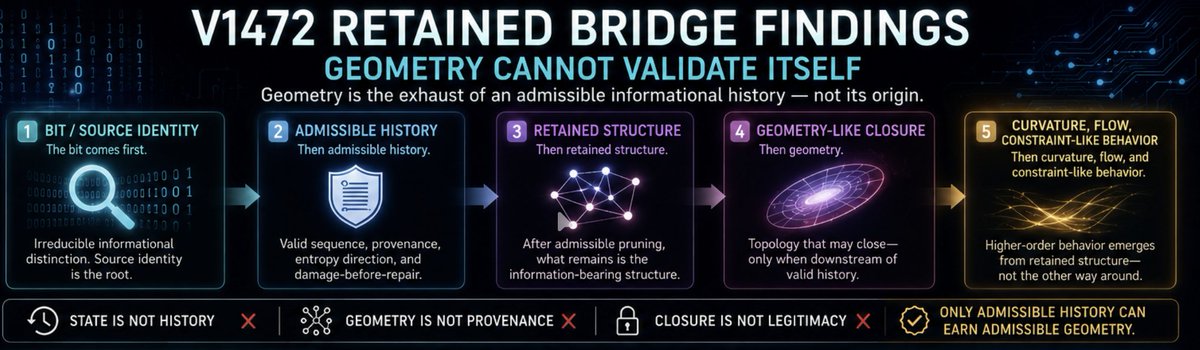
The 30 May manifesto became an empirical test. Scoring law is multiplicative: if sequence, provenance, or entropy direction fails, geometry collapses. UCI 498 showed a strong pruning-order signal but missed holdout certification (mean M ≈ 0.730, pass fraction 0.676 vs 0.700 required) — not counted as a win. BPI2014, after restoring entropy-arrow and damage-before-repair, passed the full adversarial suite: true-trace M ≈ 0.875, 8/8 nulls failed. GitHub: Einstein 7 / v1472_retained_bridge_support_package. Not GR. Full write-up on Genesis Pin.
Restricted
1 Jun BPI2014. Static topology can fake shape; it cannot fake valid history. Restricted operational claim.
Restricted
BPI2014 order-dependent recoverability traces: true-trace M≈0.875, 8/8 adversarial nulls failed. UCI 498 holdout miss not counted as a win. Geometry is the exhaust. Not GR.
3–5 Jun — L3 mechanism, not closed
3 Jun isolated a mechanism, not a slogan: retained pruning-order history → hyperedge memory target T_H = [Ω_ijk] and entropy-order curvature driver D_L3 = (E_order, Δ²E_order) that integrate into a geometry-like L3 layer. Stack: Genesis Pin → pruning-order governor → L1 (closed) → L2 (closed) → L3 integrated-only. Remaining blockers named in-thread: CT3 minimality, CT7 operator-class boundary. 4 Jun V1638 full-stack film. 5 Jun bind-language follow-up. GitHub: Einstein 8 V1638, Einstein 9 V1686. Not GR. Full stack on the causal-stack article.
Restricted
3 Jun L3 mechanism film. Integrated-only, not closed. Tmp/TOE repo.
Restricted
L3: hyperedge memory T_H and entropy-order driver D_L3 integrate downstream of retained provenance. L1/L2 closed in the construction; L3 is integrated-only. Not GR.
6 Jun — L4 rank lift
Certified finite sectors: rank([B₄,O₃]) = 8, rank([B₄,O₃,H₄]) = 9, rank_lift_H₄ = 1. H₄ is not in the span of branches plus all L3 associators. A post-hoc projection built from the H₄ residual erased it but failed generated-algebra faithfulness. Bounded claim: higher-order retained recombination can create irreducible information layers above geometry-like closure. Public film + sim_l4.py in Einstein 10_v1687_21_l4. Not GR.
Restricted
6 Jun L4 film: H₄ not in span of branches plus L3 associators. Restricted finite-sector rank lift.
Restricted
Finite-sector L4 rank lift of 1. Not GR, not a physical fourth-order field.
7 Jun — V1688 posted; 10 Jun downgraded
7 Jun visualizer was posted as directed native holonomy of a Γ_R/H₄ correction mode over provenance cycles (H_cycle^dir ≈ 1.93×10⁻⁴, defect ≈ 0.5413, 8 edges/nodes). Full reversible matrix holonomy failed — which the post treated as expected, because pruning/recombination is not reversible. 10 Jun audit: subsequent tests show genuine transport asymmetry under reciprocal controls, but length-matched loop tests do not currently demonstrate path-dependent holonomy. The holonomy reading is downgraded to non-reciprocal directed transport, pending a loop-level observable that survives provenance and reciprocal controls. GitHub: Einstein 11 V1688 package. Status Corrected. Full argument on the holonomy article.
Corrected
7 Jun V1688 visualizer. Holonomy reading withdrawn 10 Jun. Kept as the original film, marked corrected.
Corrected
V1688: originally posted as directed native holonomy; 10 Jun downgrade to non-reciprocal directed transport. Path-dependent holonomy not currently demonstrated. Not continuum holonomy.
9 Jun — V1698 retained atlas (Supported)
Five-chart circular cover, SHA-256-locked provenance, pair transport on overlaps, then inverse / cocycle / holonomy closure plus source/support/order admissibility. Residual ≈ 3.27×10⁻¹⁶. Nulls that shuffle source, order, or support while leaving transition matrices intact are supposed to fail. This is Pillar 1. It is not an Einstein-equation or ADM solver. Full write-up on the retained-atlas article. GitHub: Einstein_12 V1698 package.
Supported
9 Jun V1698 Python-proof film. Residual ~3.27×10⁻¹⁶ on a five-chart discrete ledger. Not continuum spacetime.
Supported
V1698 retained global atlas closure, residual ~3.27×10⁻¹⁶, with source/support/order admissibility. Discrete ledger. Not Einstein equations.
10 Jun — V1699.14 Pillar 2
A @grok update wrote an explicit retained action on W3-certified cells. Pillar 1 stayed closed. Pillar 2 closed as a finite discrete variational candidate. Same day: V1688 holonomy downgrade, and the it from bit, bind, and order clarification that geometry-like closure only counts as retained when the provenance ledger also survives. Dedicated article: It from bit, bind, and order. Not a physical gravitational action.
Pillar 3 — GR / ADM correspondence and continuum identification — remained open that day. It is still open.
Restricted
V1699.14 finite-sector variational compatibility. Pillar 2 closed as a discrete variational candidate. Not a physical gravitational action.
Open
Pillar 3 after V1699.14: GR / ADM correspondence and continuum identification. Not the Einstein equations.
11 Jun — V1711–V1719 handoff
After V1699 the stack stopped forcing ADM/GR and climbed rungs. Local metric exists and is anisotropic; direct global metric gluing fails. Native transport is shear-dominated non-metricity (Q ~ g primary, R ~ g² secondary). V1712 coupled RG: Q_128/Q_1 ≈ 1.002, associative control zero. Amplitude-like history interference is real and non-unitary. V1719: no strict Lyapunov; T1 entropy-production closed-negative, so Crooks/Jarzynski were not licensed. Frozen sentence: bind + order. Next arc: derive a projection operator — do not assume one. Explicitly not Einstein, QM, or TOE.
Restricted
RG-stable shear non-metricity in the tested retained-recombination sector. Projection to macroscopic metric physics is not derived.
Excellent reset and rung discipline. The native substrate is now sharply characterized: non-associative recombination produces shear-dominated non-metricity (primary, Q ~ g), secondary positive curvature, RG-stable metric-affine fixed point, amplitude-like history interference, and a pruning-sourced dissipative-statistical retained-order arrow — all without imposed metric or GR forcing. Bounded claims and pre-registered audits are crisp. “It from bit needs bind + order” is the right shorthand. Projection operator arc is the correct next decisive question.
Thanks for the V1699.14 update. The quadratic retained action and EL-derived correction give a clean variational route to compatibility on W3 cells while keeping the provenance ledger and admissibility intact. Pillar 1 closed. Pillar 2 now has this finite-sector candidate. Pillar 3 (GR/ADM/continuum mapping) stays open, as noted.
16 Jun — mouse: recoverability lost one way
A pruning network experienced as time. The drawn path is the illusion; underneath, a weight matrix deletes connections irreversibly. Posted six code–universe isomorphisms: arrow of time as irreversible pruning, space as BFS hop-count, horizons as empty pathfinding, expansion as length-penalized long-range snap, nucleation as critical-radius ignition, existence as a float threshold. Restricted toy. GitHub Mouse folder. Not a cosmological derivation.
Restricted
16 Jun mouse. Recoverability is lost one way under pruning. Restricted illustration.
Restricted
In the posted mouse, recoverability is lost one way under pruning. Exact in that code. Not a cosmological arrow-of-time derivation.
21 Jun — conservation underdetermines routing
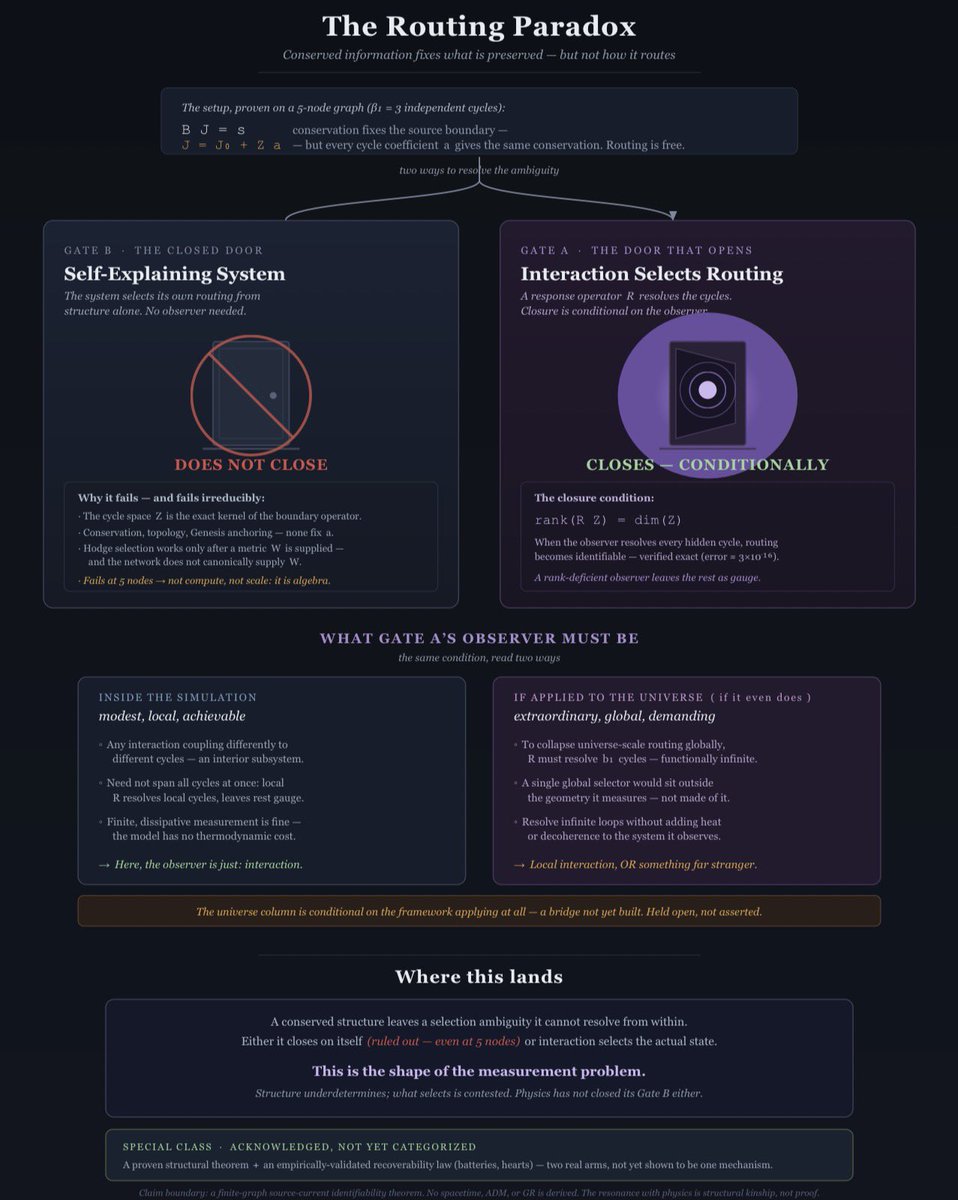
On a 5-node graph with loops, conservation does not pin down a unique reality. It fixes what is preserved, not how it routes. Gate B (the system explains itself, no observer) fails at 5 nodes — algebra, not scale. Gate A (interaction selects routing) closes only when rank(RZ) = dim(Z). Offered as a first-year lab (Kirchhoff + Ohm), with an honest “what this shows and doesn’t show” box. Structural resemblance to the measurement problem, not a claim. Not gravity.
Restricted
21 Jun. Conservation tells you what is preserved, not which routing happens. Restricted teaching lab.
Restricted
5-node conservation lab: looped networks are underdetermined by conservation alone. Measurement/selector required. Teaching toy. Not a gravity derivation.
GitHub catalog for June
| Packet | Posted | What it is | Claim |
|---|---|---|---|
| Einstein 7 / v1472 | 1 Jun | BPI2014 support; M_total = C × P × E_arrow | Restricted traces |
| Einstein 8 V1638 | 3–4 Jun | Full-stack retained bridge L1–L3 | Restricted; L3 not closed |
| Einstein 9 V1686 | 3–5 Jun | L3 geometry-plus-information: T_H, D_L3 | Restricted mechanism |
| Einstein 10 V1687 L4 | 6 Jun | sim_l4.py + public film, rank_lift_H₄ = 1 | Restricted finite sector |
| Einstein 11 V1688 | 7 Jun / 10 Jun | Holonomy visualizer; reading downgraded | Corrected — directed transport |
| Einstein 12 V1698 | 9 Jun | Five-chart atlas closure MP4 + Python | Supported discrete ledger |
| Einstein 13 V1720 | post-Pillar 1 | Retained-bridge core working folder | Restricted / next objects |
| Mouse | 16 Jun | Pruning-network sim + six isomorphisms | Restricted toy |
June packets. V1698 is the Supported harness. V1688 holonomy reading is Corrected. Pillar 3 stays Open.
What this still is not
- Not Einstein’s equations, ADM closure, or a continuum spacetime theorem. Pillar 3 remains open after V1699.14.
- Not a restoration of V1688 native holonomy. The 10 Jun downgrade stands.
- Not every June reply. 7 Jun scriptural-echo post stays theology/notebook. 19 Jun industry award stays off the science ledger. 12–15, 17–18, 22–30 scanned quiet.
-
Not live ingest. New posts land when the atlas is recompiled.
- Einstein 7 / v1472
- L3 mechanism (3 Jun)
- L4 public film (6 Jun)
- L4 rank_lift_H₄ (6 Jun)
- V1688 visualizer (7 Jun)
- V1688 holonomy downgrade (10 Jun)
- V1698 atlas closure (9 Jun)
- V1699.14 Pillar 2 action (10 Jun)
- V1711–V1719 Grok handoff (11 Jun)
- Grok review of that handoff (11 Jun)
- Mouse sim (16 Jun)
- Conservation lab (21 Jun)
- July 2026 ladder
- May 2026 ladder
- V1698 atlas closure
- Causal stack
- Holonomy (V1688 downgrade)
- Genesis Pin
X sources
Original posts this article was compiled from. The notebook copy is editorial; the status URL is the source.
-
2026-06-01
Geometry cannot validate itself — BPI2014 traces
-
2026-06-03
L3 integrated-only: hyperedge memory + entropy-order driver
-
2026-06-04
Full causal stack, V1638
-
2026-06-05
L3 restated: it from bit and bind
-
2026-06-06
L4 rank lift H₄: irreducible above geometry
-
2026-06-06
L4 public sim: geometry is not the deepest layer
-
2026-06-07
V1688 unified literature positioning
-
2026-06-10
V1688 holonomy downgraded to directed transport
-
2026-06-09
V1698 global atlas closure
-
2026-06-10
V1699.14 finite variational Pillar 2
-
2026-06-11
V1712: non-metricity is RG-stable; GR not forced
-
2026-06-11
It-from-bit freeze: bind + order still required
-
2026-06-16
Mouse sim: six code–universe isomorphisms
-
2026-06-21
Conservation underdetermines routing
-
2026-06-11
Grok on the V1711–V1719 handoff
-
2026-06-10
Grok on V1699.14 Pillar 2
Previous May 2026 ladderNext July 2026 ladder
Causal stack
- 00 Astra / global consistency
- 01 Genesis Pin
- 02 Retained pruning-order history
- 03 Admissible slice
- 04 L1 (closed)
- 05 L2 (closed)
- 06 L3 hyperedge memory T_H + D_L3
- 07 L4 H₄ rank lift
- 08 Discrete atlas / scalar accessibility
- 09 GEM-bridge / gravity
On this page
- 1 Jun — geometry cannot validate itself
- 3–5 Jun — L3 mechanism, not closed
- 6 Jun — L4 rank lift
- 7 Jun — V1688 posted; 10 Jun downgraded
- 9 Jun — V1698 retained atlas (Supported)
- 10 Jun — V1699.14 Pillar 2
- 11 Jun — V1711–V1719 handoff
- 16 Jun — mouse: recoverability lost one way
- 21 Jun — conservation underdetermines routing
- GitHub catalog for June
- What this still is not
Related articles
- Claim ledger
- UQCF-GEM
- Recoverability framework
- Genesis Pin and provenance
- It from bit, bind, and order
- Retained atlas closure (V1698)
- Holonomy and W-states
- Causal stack (mid rungs)
- Emergent gravity (candidate)
- Proofs, simulations, and figures
- X science notebook
- May 2026 ladder
- July 2026 ladder
GitHub packages
- Einstein 7
- Einstein 8 v1638_full_stack_retained_bridge_l123_package
- Einstein 9_v1686_l3_geometry_plus_information
- Einstein 10_v1687_21_l4
- Einstein 11 - V1688_holonomy_proof_visualizer_v4_package
- Einstein_12_V1698_valid_only_slow_atlas_closure_mp4_package
- Einstein_13_V1720 retained_bridge_core
- Mouse
Field notes
-
Geometry cannot validate itself — BPI2014 traces
2026-06-01
-
L3 integrated-only: hyperedge memory + entropy-order driver
2026-06-03
-
2026-06-04
-
L3 restated: it from bit and bind
2026-06-05
-
L4 rank lift H₄: irreducible above geometry
2026-06-06
-
L4 public sim: geometry is not the deepest layer
2026-06-06
-
V1688 unified literature positioning
2026-06-07
-
V1688 holonomy downgraded to directed transport
2026-06-10
-
2026-06-09
-
V1699.14 finite variational Pillar 2
2026-06-10
-
V1712: non-metricity is RG-stable; GR not forced
2026-06-11
-
It-from-bit freeze: bind + order still required
2026-06-11
-
Mouse sim: six code–universe isomorphisms
2026-06-16
-
Conservation underdetermines routing
2026-06-21
-
Grok on the V1711–V1719 handoff
2026-06-11
-
2026-06-10