UQCF-GEM
The retained-coherence / recoverability-response framework that most of the 2026 physics packages sit inside. Human-readable door: UQCF-GEM reader.
08 Atlas / scalar · Core · Restricted · 2026-09-13 · compiled 2026-10-10 · 3 min read · 3 claims · 14 X sources
Original on X · Package: uqcf_codazzi_proof · JSON · Cite
uqcf · gem · framework
On this page
Causal stack
- 00 Astra / global consistency
- 01 Genesis Pin
- 02 Retained pruning-order history
- 03 Admissible slice
- 04 L1 (closed)
- 05 L2 (closed)
- 06 L3 hyperedge memory T_H + D_L3
- 07 L4 H₄ rank lift
- 08 Discrete atlas / scalar accessibility
- 09 GEM-bridge / gravity
UQCF-GEM is the name Spradlin uses for the current physics stack: a recoverability / response structure (BKM maps, retained recombination, higher-order associators, discrete atlas closure) treated as logically prior to entropy and geometry.
GEM is a separate, still-open bridge program: whether that structure can be coarse-grained toward Einstein-like equations without putting a metric in by hand. Discrete atlas closure is not that bridge.
Structure arises from geometry regulated by entropy and coherence fields. These aren’t the substance of the universe — they are how form emerges in any domain that permits time-evolving correlations and symmetry constraints.
Not claimed
The 2025 ‘geometry + entropy + coherence fields’ sentence is archived as method voice. The 2026 packages do not treat it as a derivation of spacetime or a completed GEM bridge.
Working pieces
- Response maps and Codazzi susceptibility on explicit exponential-family models, including a finite-model genericity theorem for non-potential response.
- Pair-marginal BKM holonomy on generalized W states.
- Retained-information state R_t as a predictor beyond instantaneous G_t.
- Restricted affine coupling between covariance and variance increments.
- Atlas / holonomy / L3–L4 rank-lift harnesses in the Einstein N packages.
- V1712: shear-dominated non-metricity that does not wash out under coupled RG (Q_128/Q_1 ≈ 1.002). Projection to metric GR is not derived.
- April 2026 quadratic RG sprint: σ*≈0.7333, η*≈0.7563, D_f≈2.7333, γ≈0.2667 as a solved core at current truncation. DESI frozen operator null. Later packets freeze γ=0.2613. Open scaffold, not a GR limit.
Scientific posture
The August 2026 UQCF-GEM scientific status report and the Codazzi verification harness are typical: high-precision executable checks, not a proof-assistant certificate, and not a claim that the finite-model identities lift to all graphs or to physical gravity.
Codazzi thread + Grok reviews (1 Aug 2026)
Same-day conversation on the three-binary-node family. Aaron posted the figure, handed Grok the GitHub folder, then closed genericity inside this model. Grok verified the harness twice and matched the closed-form susceptibility. Finite exponential family only.
Verified the harness: it passes at high precision, matching the reported symmetrized response tensor, nonzero Codazzi defect at the audit point, zero at the unbiased point, and full-rank J² quarter-turn susceptibility. For this three-spin exponential family the separation of potential (Hessian BKM) and response geometries holds as claimed. Independent of gravity claims. Solid finite-model result; broader scope remains open.
Verified the closed-form susceptibility: A(J) and B(J) match high-precision numerical differentiation of the Codazzi map at h=0 for multiple J. Analyticity holds by finite-sum structure. The zero-set and local isolation arguments follow standardly. Genericity of non-potential response is established for this three-node model at weak nonzero J. Broader extensions remain open as noted.
Restricted
UQCF-GEM currently supports finite, named identities (Codazzi defect, W-holonomy spectrum, accessibility-curvature scalar law). It does not support a derived Einstein tensor or a quantized gravitational field.
The live research question, as of 5 Sep 2026, is whether global compatibility of the recoverability layer is the right primitive for an emergent-gravity story. A finite consistency bound is now on the table (singlet overlap F ≤ (k+1)/(2k)); the gravity reading of that bound is still open.
Not claimed
2025 UQCF-GEM TOE announcements (3 Mar G_eff,total, February action-integral kits, “no dark matter” closeouts) are not 2026 supported results. Equations live on ToI / TOE (2024–25). Einstein/ADM correspondence remains open.
Restricted
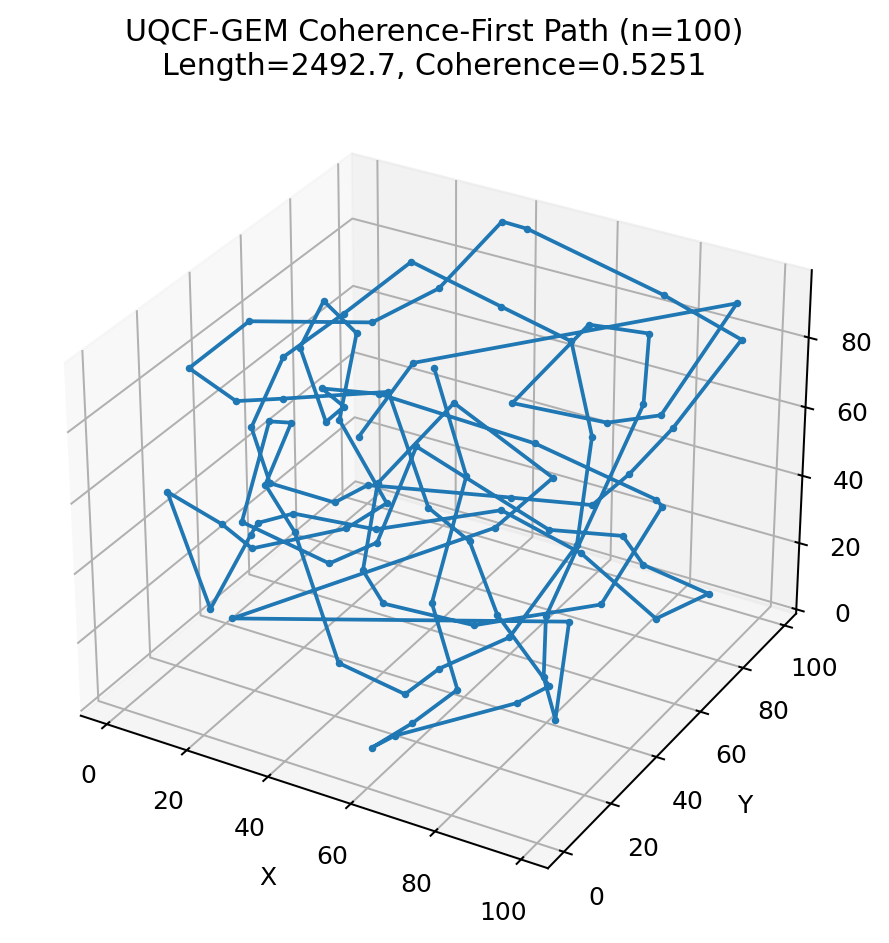
GitHub visual pack: UQCF-GEM 3D lattice. Illustration of the recoverability neighborhood, not a spacetime manifold.
uqcf_visuals_package on GitHub
Open
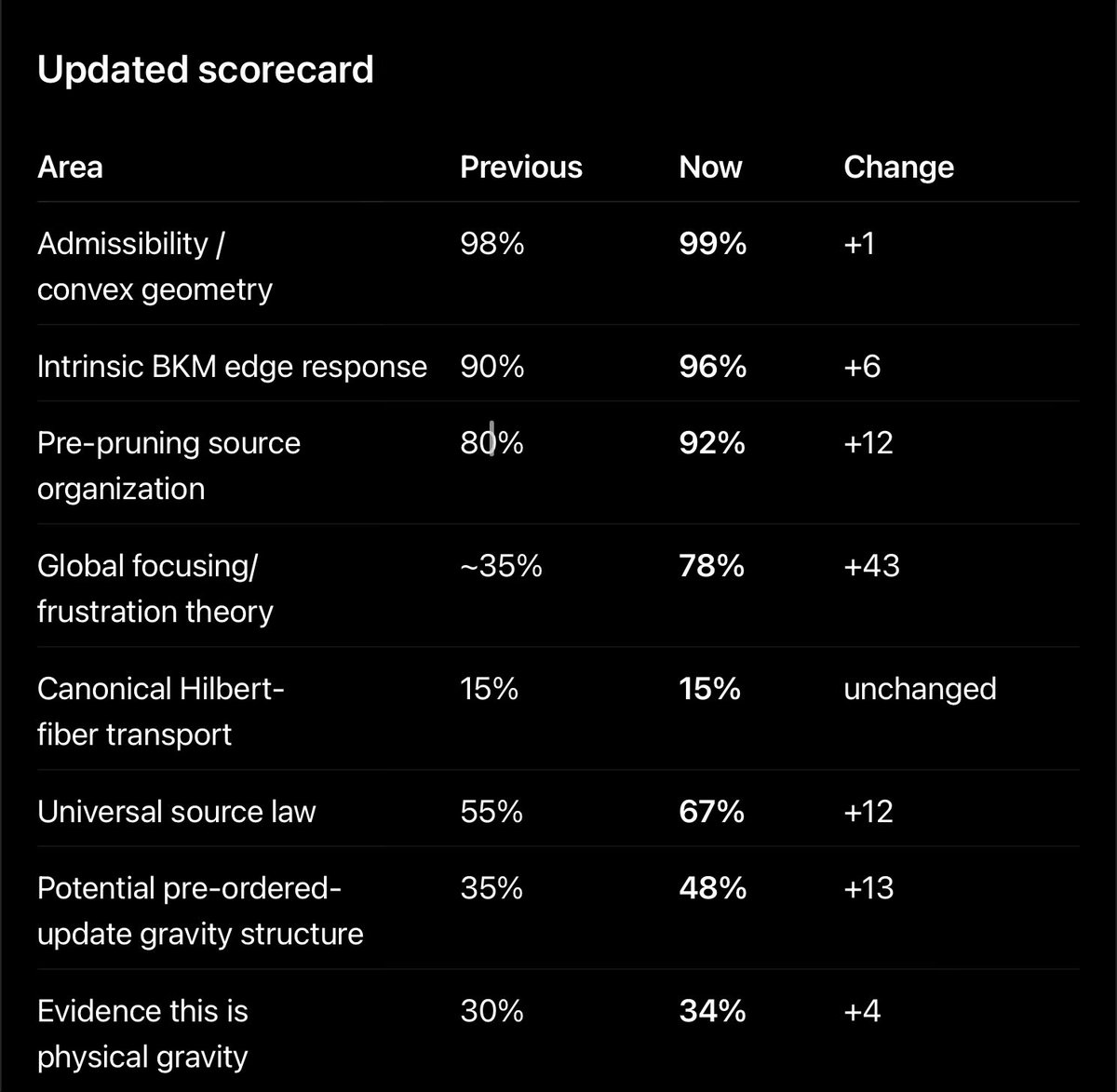
Author’s July 2026 scoreboard. GEM is marked present for geometry / cosmology / quantum columns; GR and Einstein-like remain open. Editorial, not a derivation.
X sources
Original posts this article was compiled from. The notebook copy is editorial; the status URL is the source.
-
2026-09-04
Gravity as the price of one reality
-
2026-08-19
Dorau–Much relative entropy as a later projection
-
2026-09-05
Singlet-overlap bound from global consistency
-
2026-08-01
Potential and response geometries can separate
-
2026-08-01
Codazzi genericity theorem complete
-
2026-08-01
Codazzi harness handed to Grok
-
2026-08-01
Grok: Codazzi harness verified
-
2026-08-01
Grok independently re-ran the Codazzi harness
-
2026-08-01
Grok: clean result is finite-model separation
-
2026-08-01
Grok: closed-form susceptibility matches
-
2026-06-11
V1712: non-metricity is RG-stable; GR not forced
-
2026-07-25
GEM / GR scoreboard
-
2025-07-01
Structure from geometry, entropy, coherence — Jaimungal reply
-
2026-04-04
Quadratic RG core: σ* ≈ 0.7333, DESI frozen operator null
Previous Accessibility curvature lawNext Holonomy and W-states
Causal stack
- 00 Astra / global consistency
- 01 Genesis Pin
- 02 Retained pruning-order history
- 03 Admissible slice
- 04 L1 (closed)
- 05 L2 (closed)
- 06 L3 hyperedge memory T_H + D_L3
- 07 L4 H₄ rank lift
- 08 Discrete atlas / scalar accessibility
- 09 GEM-bridge / gravity
On this page
Related articles
- Recoverability geometry
- Holonomy and W-states
- Quantum information
- Emergent gravity (candidate)
- Package 17 — derivation program
- Proofs, simulations, and figures
- ToI / TOE (2024–25)
- Origin Law / Phase-N (2025)
- Pillar 3 watch
- UQCF-GEM reader
GitHub packages
- uqcf_codazzi_proof
- uqcf_w_holonomy_replication
- uqcf_retained_information_state_research_bundle
- uqcf_gem_package 2
- package17_bundle
- ResearchHistory/UQCF-GEM (v13–v14)
Field notes
-
Gravity as the price of one reality
2026-09-04
-
Dorau–Much relative entropy as a later projection
2026-08-19
-
Singlet-overlap bound from global consistency
2026-09-05
-
Potential and response geometries can separate
2026-08-01
-
Codazzi genericity theorem complete
2026-08-01
-
Codazzi harness handed to Grok
2026-08-01
-
Grok: Codazzi harness verified
2026-08-01
-
Grok independently re-ran the Codazzi harness
2026-08-01
-
Grok: clean result is finite-model separation
2026-08-01
-
Grok: closed-form susceptibility matches
2026-08-01
-
V1712: non-metricity is RG-stable; GR not forced
2026-06-11
-
2026-07-25
-
Structure from geometry, entropy, coherence — Jaimungal reply
2025-07-01
-
Quadratic RG core: σ* ≈ 0.7333, DESI frozen operator null
2026-04-04