Restricted bridge theorems
Affine coupling, hierarchical selectors, and fractal corollaries — frozen restricted, not universal.
03 Admissible slice · Result · Restricted · 2026-09-06 · compiled 2026-10-10 · 1 min read · 1 claim · 5 X sources
Original on X · Package: ai_peer_review_bundle_v1 · JSON · Cite
bridge · affine · theorem · fractal
On this page
Causal stack
- 00 Astra / global consistency
- 01 Genesis Pin
- 02 Retained pruning-order history
- 03 Admissible slice
- 04 L1 (closed)
- 05 L2 (closed)
- 06 L3 hyperedge memory T_H + D_L3
- 07 L4 H₄ rank lift
- 08 Discrete atlas / scalar accessibility
- 09 GEM-bridge / gravity
The restricted-bridge program is where the work is most theorem-shaped and most careful. Theorem Packet v27 freezes a hierarchy: a universal compact / admissibility / local-residual layer, then a restricted bridge layer whose strongest draft is a covariance–variance coupling with a robust slope band and an explicit empirical validity region.
a₀ and b₀ arise from baseline residual geometry; ε is controlled by gain drift, response curvature, and innovation scale. The operational default is a utility-maximizing stack; a balanced operating point is kept only as a softer interpretive alternative.
Bridge-closure status
The consolidated status note no longer treats the bridge as a loose hypothesis. It reports a hierarchical selector (not a flat one), real local seam structure, strong family and perturbation transfer, and a lower weak ladder from nested thresholding of a normalized retained-envelope variable.
Restricted
A retained-state bridge built from normalized residual-envelope coordinates supports a low-complexity hierarchical selector with real local seam structure, strong family and perturbation transfer, renormalizable scale behavior, and a lower weak ladder. This is the strongest admissible bridge claim — not TOE closure.
V395 → V421 survival law
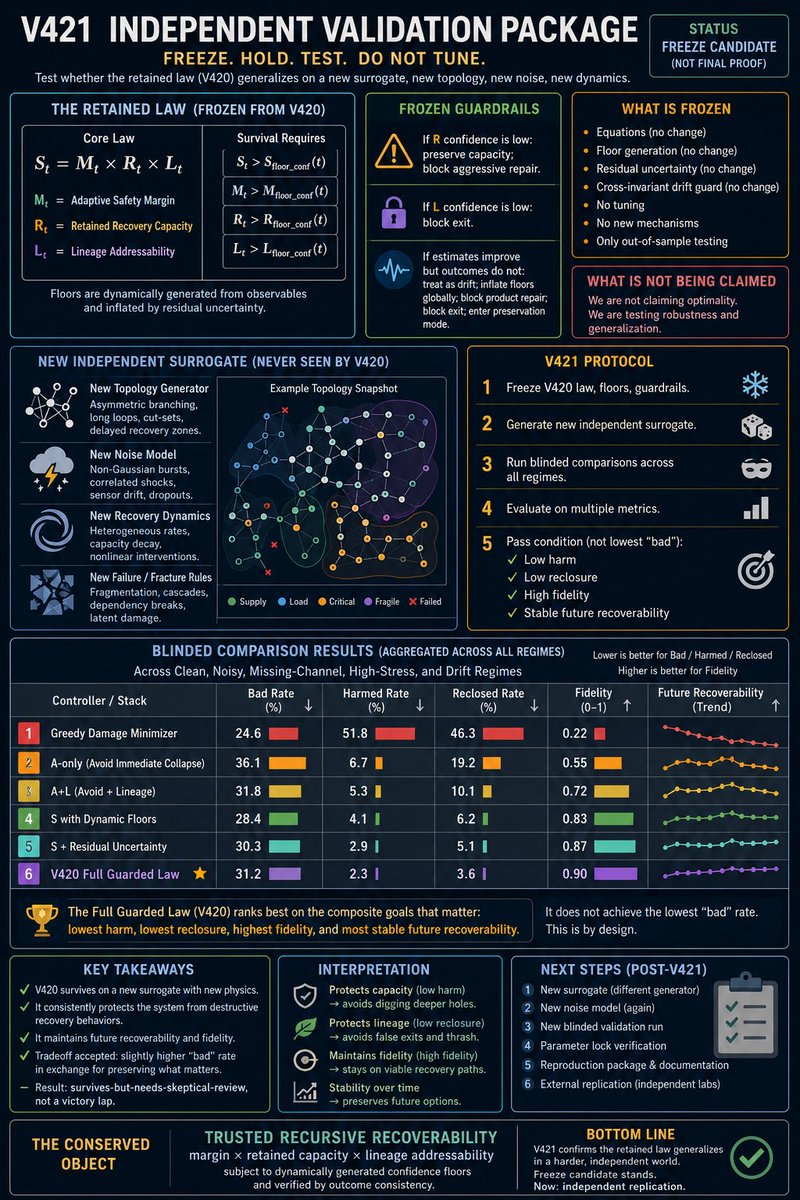
A parallel compression: A_t = M_t × R_t was not enough. Immediate recovery did not predict delayed collapse or post-exit fidelity, forcing lineage addressability L_t and the recursive law S_t = M_t × R_t × L_t. V421 was a blinded generalization test (new topology, noise, fracture; no coefficient retuning). Greedy minimizers still win short-term bad rate; the retained law minimized harm, false exit, reclosure, lineage destruction, and long-horizon fidelity collapse.
Restricted
V421 blinded generalization: new topology, noise, and fracture; no coefficient retuning. Python, results, and data were posted with the figure.
Restricted
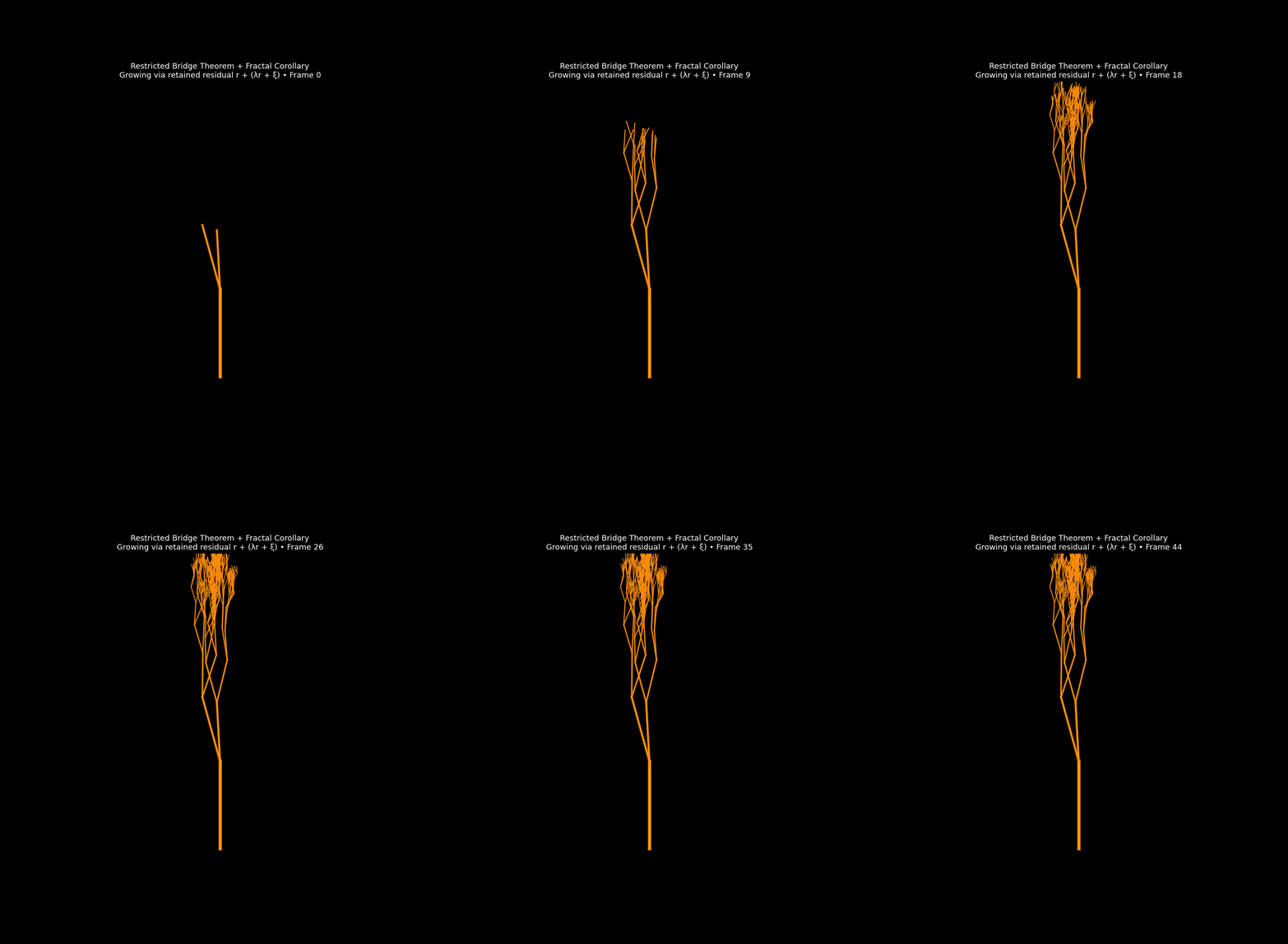
Restricted-bridge fractal growth GIF from the TOE tree. Restricted corollary, not a universal law.
restricted_bridge_fractal_growth.gif on GitHub

X sources
Original posts this article was compiled from. The notebook copy is editorial; the status URL is the source.
-
2026-05-13
From A_t to the recursive survival law
-
2026-05-14
V513 conformal recoverability — theorem candidate
-
2026-05-10
Native residual energy predicts repair
-
2026-05-10
Retained Branch Identity audit: address map or wipe
-
2026-05-14
V498 retained-geometry Python proof
Previous Recoverability frameworkNext Package 17 — derivation program
Causal stack
- 00 Astra / global consistency
- 01 Genesis Pin
- 02 Retained pruning-order history
- 03 Admissible slice
- 04 L1 (closed)
- 05 L2 (closed)
- 06 L3 hyperedge memory T_H + D_L3
- 07 L4 H₄ rank lift
- 08 Discrete atlas / scalar accessibility
- 09 GEM-bridge / gravity
On this page
Related articles
GitHub packages
- ai_peer_review_bundle_v1
- restricted_fractal_publication_bundle
- final_bridge_manuscript_and_supporting_materials
- v498_retained_geometry_formal_report_package
- v395_full_stack_proof_kit
- v421_independent_validation_package
Field notes
-
From A_t to the recursive survival law
2026-05-13
-
V513 conformal recoverability — theorem candidate
2026-05-14
-
Native residual energy predicts repair
2026-05-10
-
Retained Branch Identity audit: address map or wipe
2026-05-10
-
V498 retained-geometry Python proof
2026-05-14