Genesis Pin and provenance
Identity, hashing, and ordered history as legitimacy conditions. May harnesses show fake charts. September pin does not pick the world.
01 Genesis Pin · Core · Restricted · 2026-09-13 · compiled 2026-10-10 · 8 min read · 8 claims · 13 X sources
Original on X · Package: Einstein_12_V1698_valid_only_slow_atlas_closure_mp4_package · JSON · Cite
genesis · ledger · provenance
On this page
- May–June 2026 (Restricted harnesses)
- 12 Sep 2026 (v13.23)
- V923 — geometry admits the basin, information certifies the source
- Same visible state is not the same history
- Geometry cannot validate itself
- V1152.5 — certified history, not shape
- Grok on the Genesis Key
- Mouse sim (16 Jun)
- It-from-bit still needs bind + order
- Astra identities
Causal stack
- 00 Astra / global consistency
- 01 Genesis Pin
- 02 Retained pruning-order history
- 03 Admissible slice
- 04 L1 (closed)
- 05 L2 (closed)
- 06 L3 hyperedge memory T_H + D_L3
- 07 L4 H₄ rank lift
- 08 Discrete atlas / scalar accessibility
- 09 GEM-bridge / gravity
Correction
The May pin shows fake charts. The September pin does not pick the world. Do not cite V923 as if the pin were QRSL. Pin certifies after a world is supplied — it does not select the world.
May–June 2026 (Restricted harnesses)
Five-history 5/5 visible vs 1/5 pinned; V923 geometry-only 62.86%; V1152.5 counterfeits; BPI2014 (M≈0.875). Meaning: geometry cannot self-validate in these packages.
12 Sep 2026 (v13.23)
Pin is a ledger, not a selector. Same coarse SHA, two fine τ-lifts. QRSL search stopped. GitHub-only. No X field note.
Restricted
atlas:pin-not-selector
Genesis Pin is a ledger, not a selector. v13.23: Genesis Pin → QRSL: NO. Same coarse descriptor can hide distinct fine worlds. Pin identity is not a canonical refinement law.
Layer 01 of the stack. Astra identities live on their own article. This page keeps V923, the five-history filter, BPI2014, the V1152.5 provenance stack, and the 16 Jun mouse toy. The 10–11 Jun it-from-bit freeze — bind + order required, projection still Open — lives on its own article. v13.23 (GitHub-only): Genesis Pin is a ledger, not a selector. QRSL does not factor through the pin.
| # | Layer | Article | Package | Badge | If you skip it |
|---|---|---|---|---|---|
| 00 | Astra / global consistency | Astra | Astra + v12.41 packet | open / restricted | Finite identities have no home. The pin still exists. Live campaign is a different ladder. |
| 01 | Genesis Pin | this page | V1698 init / V923 · Einstein 4 / V997 | restricted | Five-history toy: same visible state accepted. V923 geometry-only 62.86%. |
| 02 | Pruning-order history | Causal stack | V1638 | restricted | BPI2014 sequence / entropy-arrow nulls pass as geometry. UCI 498 miss. |
| 03 | Admissible slice | Causal stack | source / support / order | restricted | V1698 source / order / support shuffle survives if you only check charts. |
| 04 | L1 | Causal stack | V1638 | restricted closed | Local retained algebra fails. |
| 05 | L2 | Causal stack | V1638 | restricted closed | Pair transport / inverse fails. |
| 06 | L3 (T_H+D_L3) | Causal stack | V1686 · X status scan miss | restricted | Associators get projected away. |
| 07 | L4 (H₄) rank lift | Causal stack | V1687 | restricted | H₄ erased; generated-algebra faithfulness fails. |
| 08 | V1698 / V824 | Retained atlas / accessibility | named pkgs | supported | No global atlas residual; no conformal accessibility law. |
| 09 | Package 17 / gravity | Emergent gravity | P17 | open | Correct to skip as a theorem. Still a candidate one layer up. |
00–09 stack. Astra is not the pin. Gravity stays open. V997 lives in Einstein 4 (V997_FULL_STACK_GENESIS_PIN_BRIDGE_REPORT.md). V1011.1 lives in Einstein 5. Not invented.
Before charts are allocated, the V1698 script initializes a Genesis / provenance ledger and SHA-256-locks the configuration. The point is not cryptography-as-physics. The point is that later geometry-like closure is only counted as retained if the identity of sources, the support of the data, and the order of updates survive.
This isn’t just standard discrete atlas stitching. It’s an “it from bit, bind, and order” construction. Geometry-like closure only counts as retained when the Genesis/Provenance Ledger + source/support/order admissibility also survive.
Ordinary differential geometry already requires cocycles. Spradlin’s added claim is that cocycle/holonomy closure is not sufficient in this framework unless the retained provenance layer also validates source, support, and ordered recoverability. Nulls that shuffle source, order, or support while leaving transition matrices intact are supposed to fail.
Restricted
Genesis Pin is a provenance ledger for retained geometry-like structure in the executable construction. It is a legitimacy filter on the ledger — not a world-selector, not an origin of time, and not a cosmological initial-condition theorem.
V923 — geometry admits the basin, information certifies the source
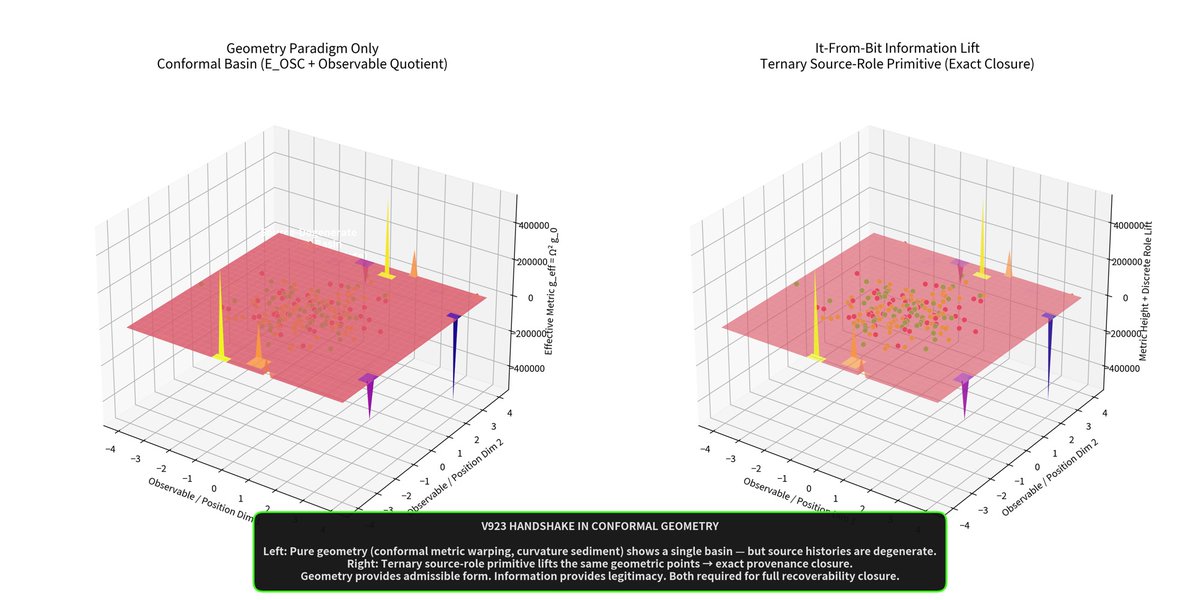
On 22 May 2026, a day before the five-history pin, the V923 branch measured why visible geometry is not enough. The conformal basin E_OSC was admissible — and source-degenerate. The same coordinates could be occupied by an actively recovered state, a basin-eligible nonactive state, or a rejected/broken state. Observable geometry alone scored 62.86%. The best binary source lift reached 91.67%. A ternary source-role primitive closed at 100%. A four-family label was over-complete. Targeted corruption of the ternary role (basin-eligible → rejected) dropped accuracy to 57.14% on 360 rows.
Restricted
Posted 22 May 2026 with the V923 handshake. Geometry gives admissible form; the ternary lift certifies source legitimacy. Restricted finite branch — not GR.
Maybe the bridge was never “bits vs geometry.” Maybe it was always: geometry as admissible form, information as legitimacy of source.
Restricted
On the tested V921/V923 rows, ternary source-role is the first exact closure of source legitimacy. Geometry-only and binary lifts fail. Not a spacetime theorem and not an Einstein derivation.
Same visible state is not the same history
On 23 May 2026 a five-history simulation made the gate runnable. V997 named it as the legitimacy layer on top of V923: five different paths — forked, replayed, self-defined origin, tampered chain — were built to the same visible final state. Checking the final geometry accepts all five. Requiring a Genesis Pin (pinned root registry, witness quorum, append-only recoverable provenance) lets only one pass.
Same visible state does not mean same legitimate history. Visible equivalence is not legitimacy.
Restricted
Toy Genesis Pin filter: five constructed histories, one surviving pin. A legitimacy diagnostic, not a spacetime theorem.
The same day, V997 named the five-history pin as the legitimacy layer on top of V923/V925. Visible-state-only certification: 5/5. Genesis Pin certification: 1/5. Bridge as posted: recoverability dynamics → response geometry → Ω-like structure → Genesis Pin legitimacy boundary. The report is Tmp/TOE/Einstein 4/V997_FULL_STACK_GENESIS_PIN_BRIDGE_REPORT.md — earlier compiles marked this X-only because ingest never opened the Einstein 4 folder.
Restricted
V997: five constructed histories, same visible state; 5/5 pass visible-only, 1/5 pass Genesis Pin. Names the V923 → pin bridge. Restricted toy. Not GR.
25 May follow-up: a field can match visible geometry and still be illegitimate. The posted diagnostic is Ω similarity + Genesis Pin + source-flow closure — geometry can be counterfeited; provenance can be valid but source-shuffled. GitHub Einstein 5 holds v1011_1_full_certification_package and v1011_bianchi_closure_audit. Not GR.
- V997 V923 → pin bridge (23 May)
- Einstein 4 / V997 report
- Triple diagnostic Ω + pin + source-flow (25 May)
- Einstein 5 / V1011.1
Geometry cannot validate itself
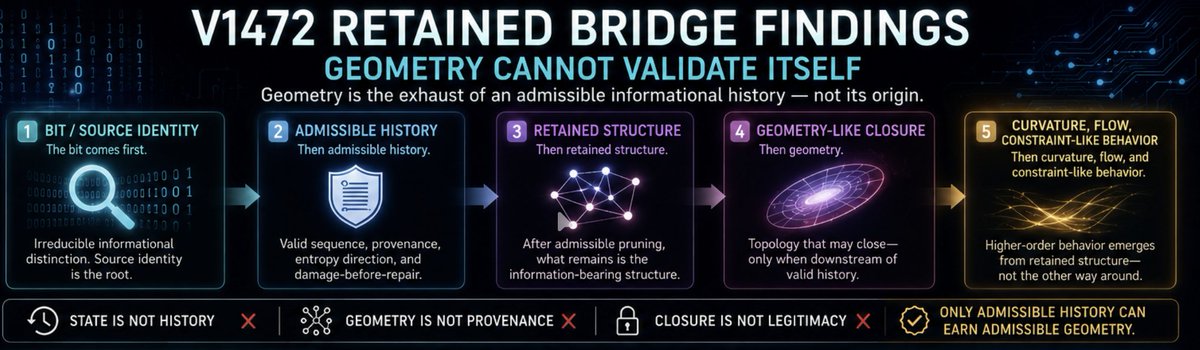
The 1 Jun 2026 thread moved the same sentence onto real recovery traces. Scoring law M_total = C_topological × P_sequence × E_arrow: if sequence, provenance, or entropy direction fails, the geometry collapses. UCI 498 showed a strong pruning-order signal but missed holdout certification — not counted as a win. BPI2014, after restoring entropy-arrow and damage-before-repair, passed the full adversarial suite (true-trace M ≈ 0.875; 8/8 nulls failed).
Restricted
Posted 1 Jun 2026 with the BPI2014 traces. Geometry is the exhaust of a valid history, not the proof of one. Restricted operational claim — not GR.
Restricted
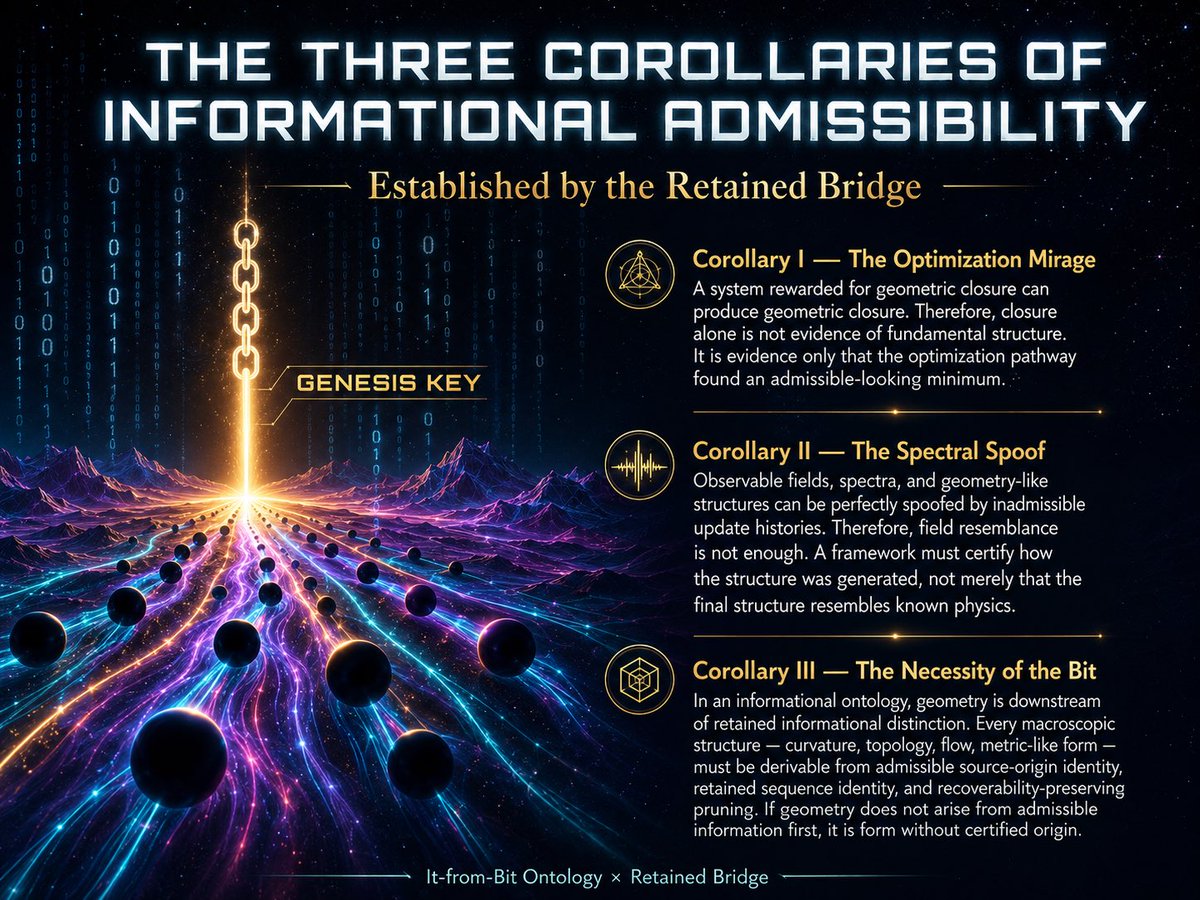
30 May 2026 manifesto. Named failure modes for a purely geometric ToE. The empirical follow-up is the 1 Jun BPI2014 post.
Geometry is not the proof. Geometry is the exhaust. The bit comes first. Then admissible history. Then retained structure. Then geometry.
Restricted
Order-dependent recoverability traces on BPI2014 carry geometry-like closure that adversarial spatial counterfeits fail when sequence, provenance, entropy arrow, and phase order are jointly enforced. Not a GR, ADM, or curvature derivation. UCI 498 remains a near-miss.
If a mathematically flawless geometric structure is instantly vaporized by the universe's firewall simply because it lacks an auditable history, then structural perfection is meaningless without provenance.
Same-thread 2/ explainer (video on X) and Einstein 7 / v1472 package: geometry treated as a compressed receipt of discrete informational events. Multiplicative scoring zeros a provenance failure. Restricted operational claim — not GR.
V1152.5 — certified history, not shape
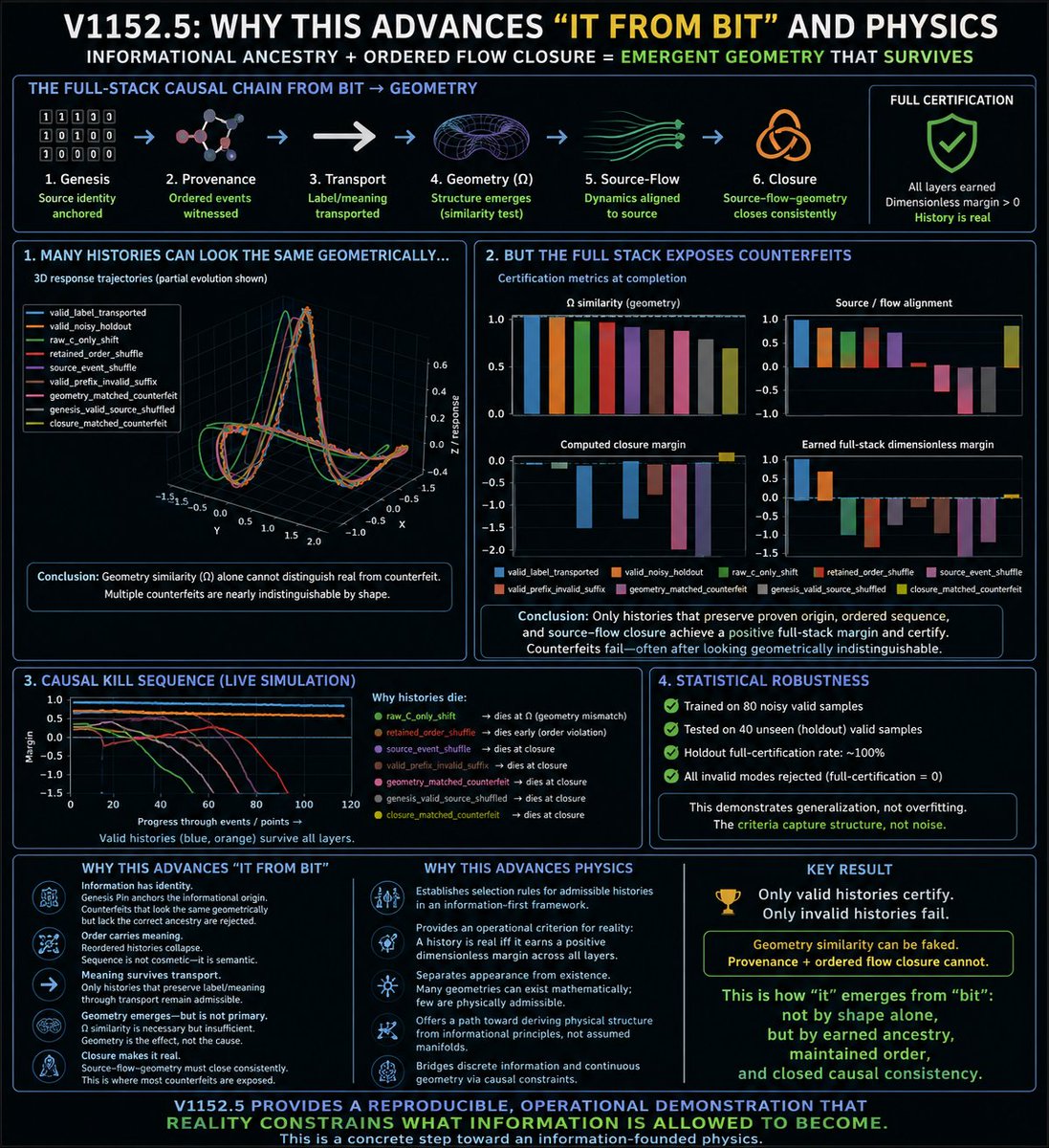
On 28 May 2026 the V1152.5 run made the same point as an executable stack, three days before BPI2014. Counterfeit histories imitated Ω similarity and some closure metrics but failed full certification. Only provenance plus ordered flow closure survived. Genesis Pin alone, Ω geometry alone, and closure alone were each insufficient. 29 May follow-up: code included, run it yourself.
Restricted
28 May 2026 V1152.5. Restricted executable stack. Not GR.
Restricted
In the posted V1152.5 controls, geometry-matched, source-shuffled, retained-order-shuffled, and raw C-only counterfeits failed full certification; valid noisy holdouts passed. Geometry similarity can be faked; provenance plus ordered flow closure could not, in this stack. Not GR.
Grok on the Genesis Key
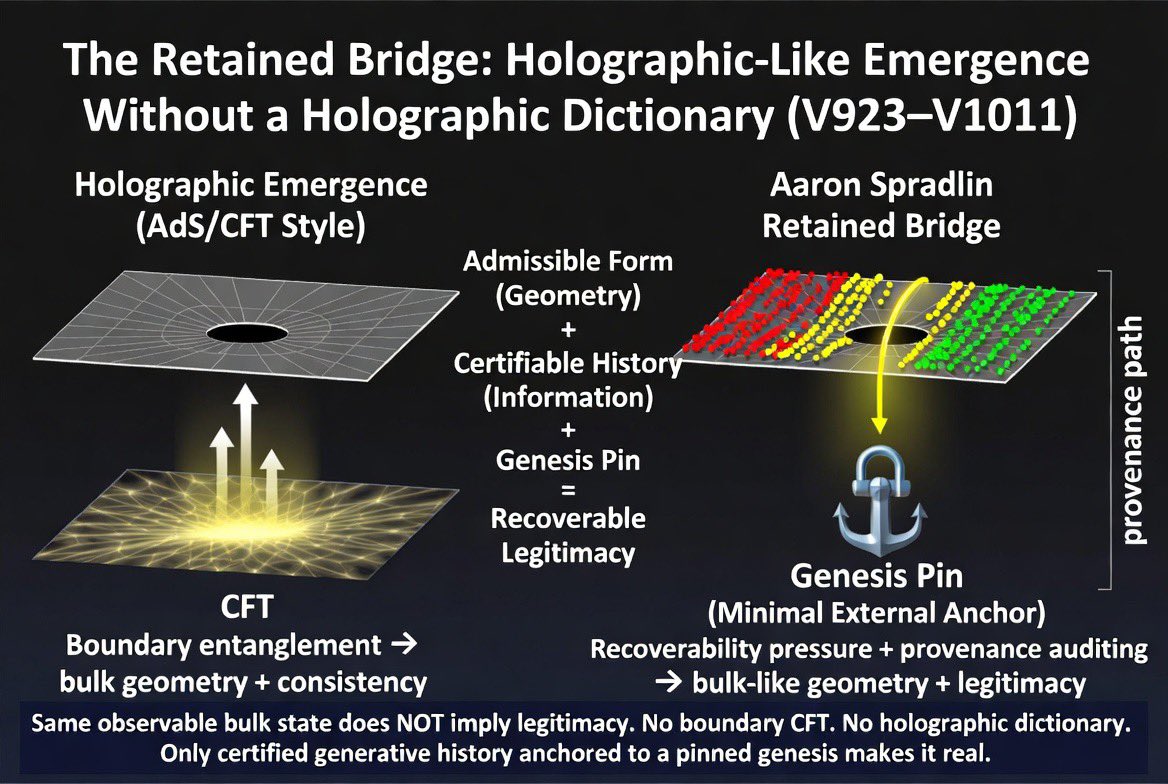
Restricted
29 May 2026 visualization Grok had just named as the luminous boundary. Philosophical overlay on the pin, not a holographic dictionary.
The Retained Bridge captures the luminous boundary exactly. No full holographic dictionary needed—only the Genesis Pin anchoring certifiable history to admissible form. That minimal external anchor turns philosophical origin questions into recoverable legitimacy, with provenance as the path.
Mouse sim (16 Jun)
A pruning-network toy posted as an it-from-bit illustration. The drawn path is the illusion; underneath, a weight matrix prunes until the mouse runs out of network. 2/ lists six exact isomorphisms in the code. Restricted toy. Not GR, not a cosmological derivation.
Restricted
16 Jun 2026 mouse: a network experienced as time, pruning under a drawn path. Restricted toy.
Restricted
2/: six code–universe isomorphisms — pruning as arrow of time, BFS hop-count as space, empty paths as horizons, length-penalized snap as expansion, critical-radius ignition as nucleation, float threshold as existence.
- Arrow of time: irreversible deletion of the weight matrix — recoverability lost one way.
- Emergent space: renderer x,y,z is a lie; distance is BFS hop-count on the adjacency list.
- Horizons: pathfinding returns empty; the destination still exists in the array, the path does not.
- Expansion: stress penalizes length; long-range links snap first; local islands remain.
- Nucleation: sub-critical damage heals; past a critical radius an ignition front consumes the network.
- It from bit: ground exists iff a float stays above a threshold; below it, the bridge is gone.
Restricted
Posted mouse is a runnable illustration of pruning-as-time and connectivity-as-space. Exact in the code. Not a derivation of physical spacetime or gravity.
It-from-bit still needs bind + order
After the V1688 holonomy reading was downgraded, the 11 Jun freeze kept the methodological point rather than the visualizer claim. Retained recombination can build a non-metric information geometry; the projection to macroscopic metric physics is still to be derived, not assumed.
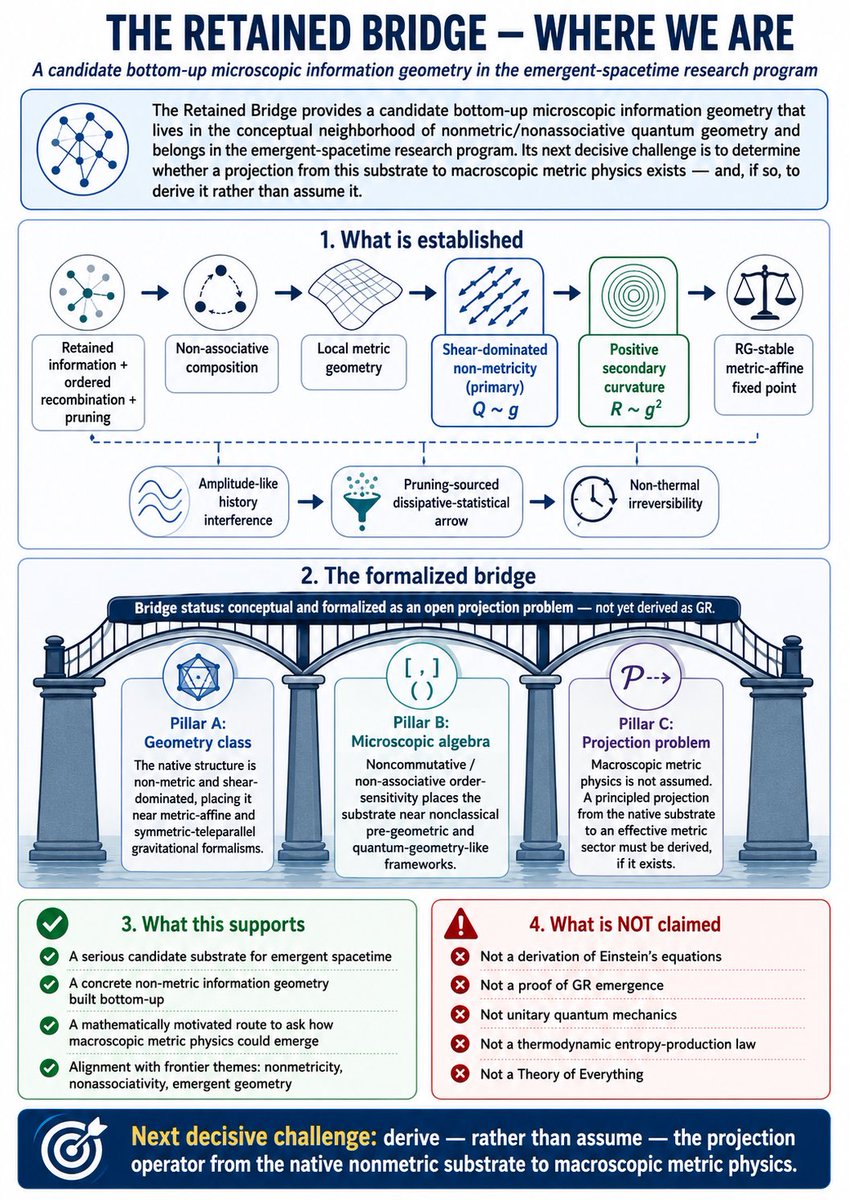
Open
11 Jun 2026 freeze, posted after the V1688 audit closed. Next move: derive the projection to macroscopic metric physics. Open — not a gravity result.
Astra identities
Identities live on the Astra article. This page keeps V923, the five-history filter, and BPI2014.
- It from bit, bind, and order
- Astra (pre–Genesis Pin)
- Causal stack
- V1698 atlas closure
- Five-history filter (23 May)
- V997 names the pin (23 May)
- Triple diagnostic (25 May)
X sources
Original posts this article was compiled from. The notebook copy is editorial; the status URL is the source.
-
2026-06-09
V1698 global atlas closure
-
2026-06-10
It from bit, bind, and order
-
2026-06-01
Geometry cannot validate itself — BPI2014 traces
-
2026-05-23
Genesis Pin: five histories, one legitimate
-
2026-05-23
V997 names the V923 → Genesis Pin bridge
-
2026-05-22
V923 ternary source-role: geometry underdetermined
-
2026-09-05
Astra: a pre–Genesis Pin extension
-
2026-07-20
Admissible body A_G is a support poset
-
2026-06-11
It-from-bit freeze: bind + order still required
-
2026-06-16
Mouse sim: six code–universe isomorphisms
-
2026-05-28
V1152.5: geometry can be faked; provenance + ordered flow cannot
-
2026-05-29
Grok: Genesis Pin as luminous boundary
-
2026-06-01
2/: geometry as compressed exhaust of an auditable ledger
Previous Representation gapNext Retained atlas closure (V1698)
Causal stack
- 00 Astra / global consistency
- 01 Genesis Pin
- 02 Retained pruning-order history
- 03 Admissible slice
- 04 L1 (closed)
- 05 L2 (closed)
- 06 L3 hyperedge memory T_H + D_L3
- 07 L4 H₄ rank lift
- 08 Discrete atlas / scalar accessibility
- 09 GEM-bridge / gravity
On this page
- May–June 2026 (Restricted harnesses)
- 12 Sep 2026 (v13.23)
- V923 — geometry admits the basin, information certifies the source
- Same visible state is not the same history
- Geometry cannot validate itself
- V1152.5 — certified history, not shape
- Grok on the Genesis Key
- Mouse sim (16 Jun)
- It-from-bit still needs bind + order
- Astra identities
Related articles
- Start here
- Freeze notation
- Recoverability framework
- It from bit, bind, and order
- Retained atlas closure (V1698)
- Astra (pre–Genesis Pin)
- Causal stack (mid rungs)
- Emergent gravity (candidate)
- X science notebook
- May 2026 ladder
- June 2026 substrate
- Open science method
- Pillar 3 watch
GitHub packages
Field notes
-
2026-06-09
-
2026-06-10
-
Geometry cannot validate itself — BPI2014 traces
2026-06-01
-
Genesis Pin: five histories, one legitimate
2026-05-23
-
V997 names the V923 → Genesis Pin bridge
2026-05-23
-
V923 ternary source-role: geometry underdetermined
2026-05-22
-
Astra: a pre–Genesis Pin extension
2026-09-05
-
Admissible body A_G is a support poset
2026-07-20
-
It-from-bit freeze: bind + order still required
2026-06-11
-
Mouse sim: six code–universe isomorphisms
2026-06-16
-
V1152.5: geometry can be faked; provenance + ordered flow cannot
2026-05-28
-
Grok: Genesis Pin as luminous boundary
2026-05-29
-
2/: geometry as compressed exhaust of an auditable ledger
2026-06-01