Frozen v9 protein bridge (1UAO / 1L2Y)
12 Apr 2026 folding-side operator: frozen UQCF-GEM bridge improved backbone ordering on 1UAO/1L2Y. Restricted in-silico. 19 Sep closeout: not a transferable new mechanism. Not full folding.
Applied · Applied · Restricted · 2026-09-19 · compiled 2026-10-10 · 2 min read · 1 claim · 2 X sources
Original on X · Package: uqcf_bridge_v9_update_bundle · JSON · Cite
protein · 1UAO · 1L2Y · v9 · bridge
On this page
Causal stack
- 00 Astra / global consistency
- 01 Genesis Pin
- 02 Retained pruning-order history
- 03 Admissible slice
- 04 L1 (closed)
- 05 L2 (closed)
- 06 L3 hyperedge memory T_H + D_L3
- 07 L4 H₄ rank lift
- 08 Discrete atlas / scalar accessibility
- 09 GEM-bridge / gravity
This is the protein transfer of the UQCF-GEM bridge layer that later shows up in the Villin HP35 R_t post. On 12 Apr 2026 Aaron posted a three-file memo plus a raw trajectory packet and asked whether a Theory of Everything, if real, should generate a testable organizing principle in a domain it was never built for. The posted answer is bounded: a frozen v9 patch produced a reproducible pre-classical ordering effect on two real small-protein targets. Not full folding. Not robust long-range contact closure. Not a TOE proof.
The current UQCF-GEM bridge implementation carries a real multiscale ordering signal that generalizes across small protein targets, especially in backbone organization. The strongest remaining limitation is not local coherence, but productive long-range contact selection and full basin discrimination.
uqcf_bridge_update_v9.md, Tmp/TOE
Scoreboard (author’s own 7.6 / 10)
| Target | Metric | Baseline | Frozen v9 | Note |
|---|---|---|---|---|
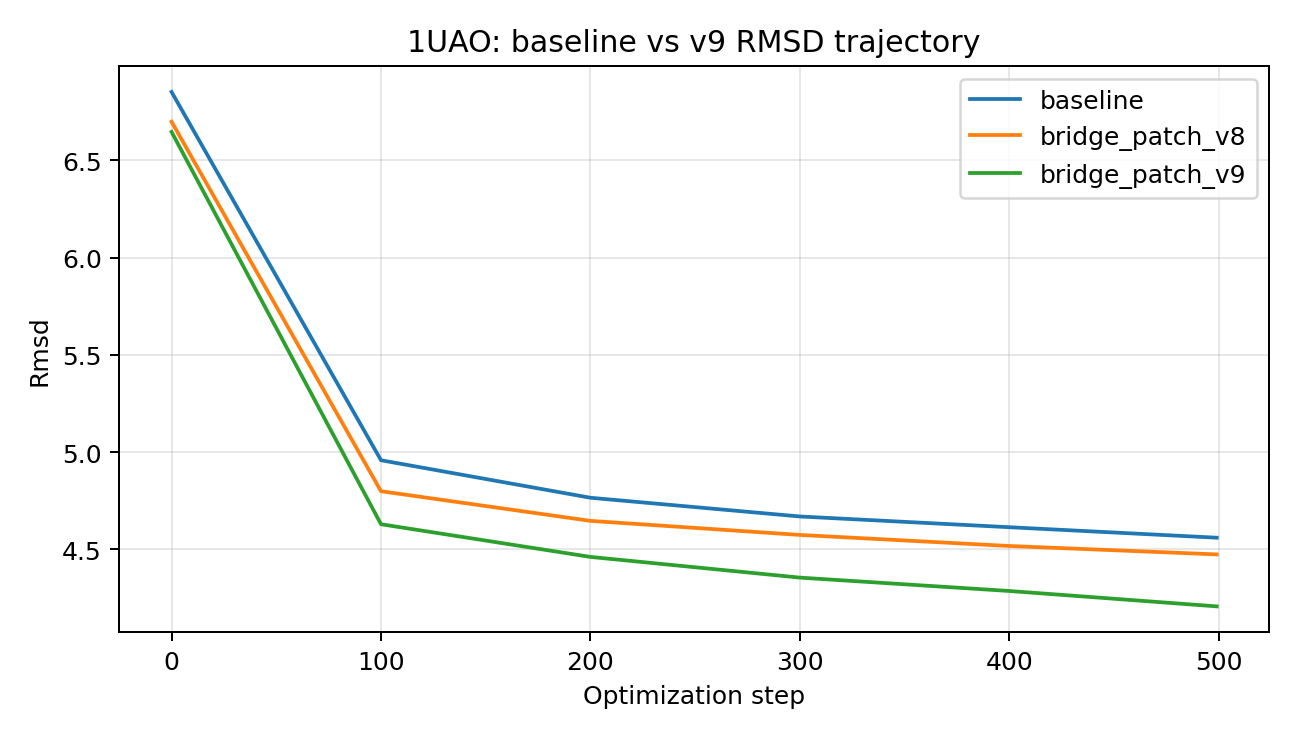
| 1UAO (chignolin) | best RMSD mean (Å) | 4.5584 | 4.2051 | Improved vs baseline and vs v8 (4.4738). Not a decisive p in the memo. |
| 1UAO | angle RMS mean | 0.8289 | 0.5809 | Strongest 1UAO move. |
| 1UAO | dihedral RMS mean | 2.0045 | 1.7647 | Improved vs baseline; v8 was 1.6894. |
| 1UAO | contact recovery mean | 0.3333 | 0.3077 | Mixed. v8 was worse (0.2308). |
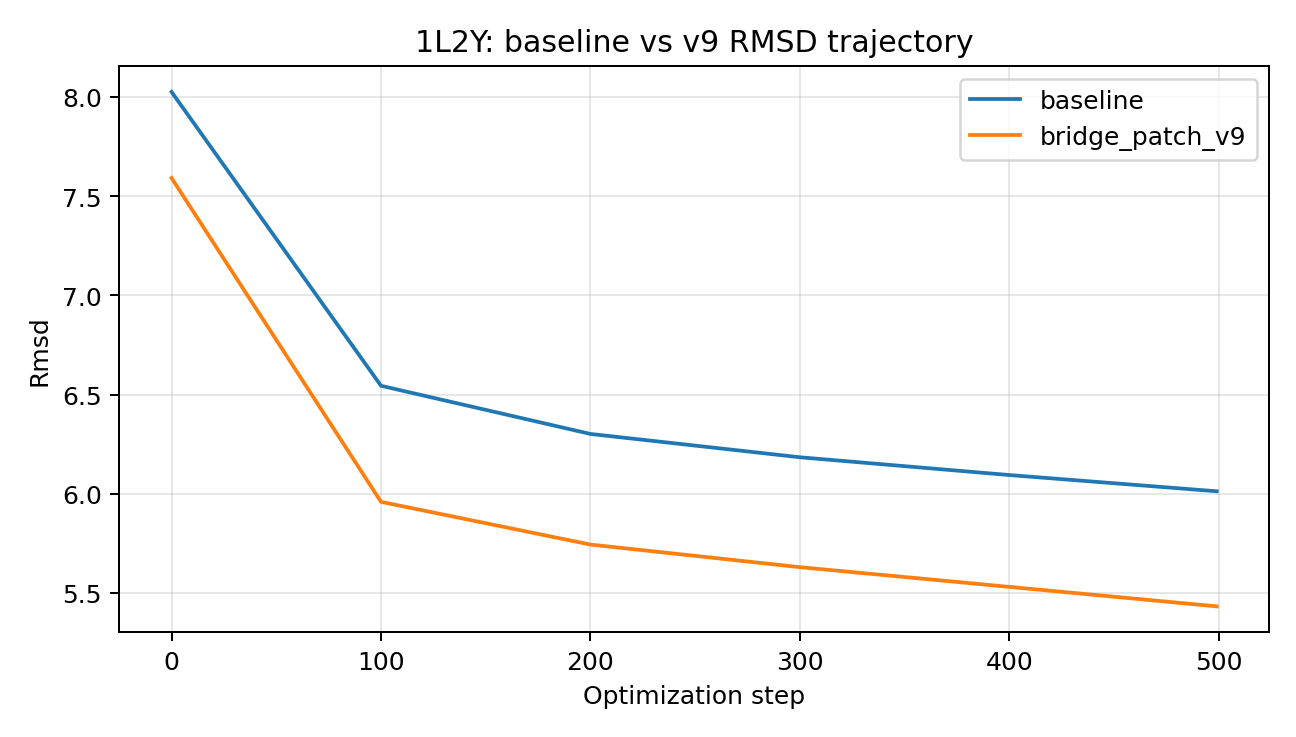
| 1L2Y (trp-cage) | best RMSD mean (Å) | 6.0021 | 5.4193 | Directional. p = 0.0655 in the memo — not decisive. |
| 1L2Y | angle RMS mean | 0.7891 | 0.6948 | p = 0.0193. The significant 1L2Y cell. |
| 1L2Y | dihedral RMS mean | 1.8387 | 1.8346 | Unchanged. |
| 1L2Y | contact recovery mean | 0.3848 | 0.4061 | Slight improvement. |
Numbers from Tmp/TOE/uqcf_bridge_v9_update_bundle CSVs and uqcf_bridge_update_v9.md. v9 is scored 7.6/10 in that memo because it transferred better than v8, not because folding is solved.
Restricted
1UAO RMSD over step: baseline versus frozen v9. Trajectory-level check that the summary gain is not only an endpoint reporting artifact.
uqcf_bridge_v9_trajectory_packet_bundle
Restricted
1L2Y RMSD over step: baseline versus frozen v9. Same frozen patch, second target.
uqcf_bridge_v9_trajectory_packet_bundle
Restricted
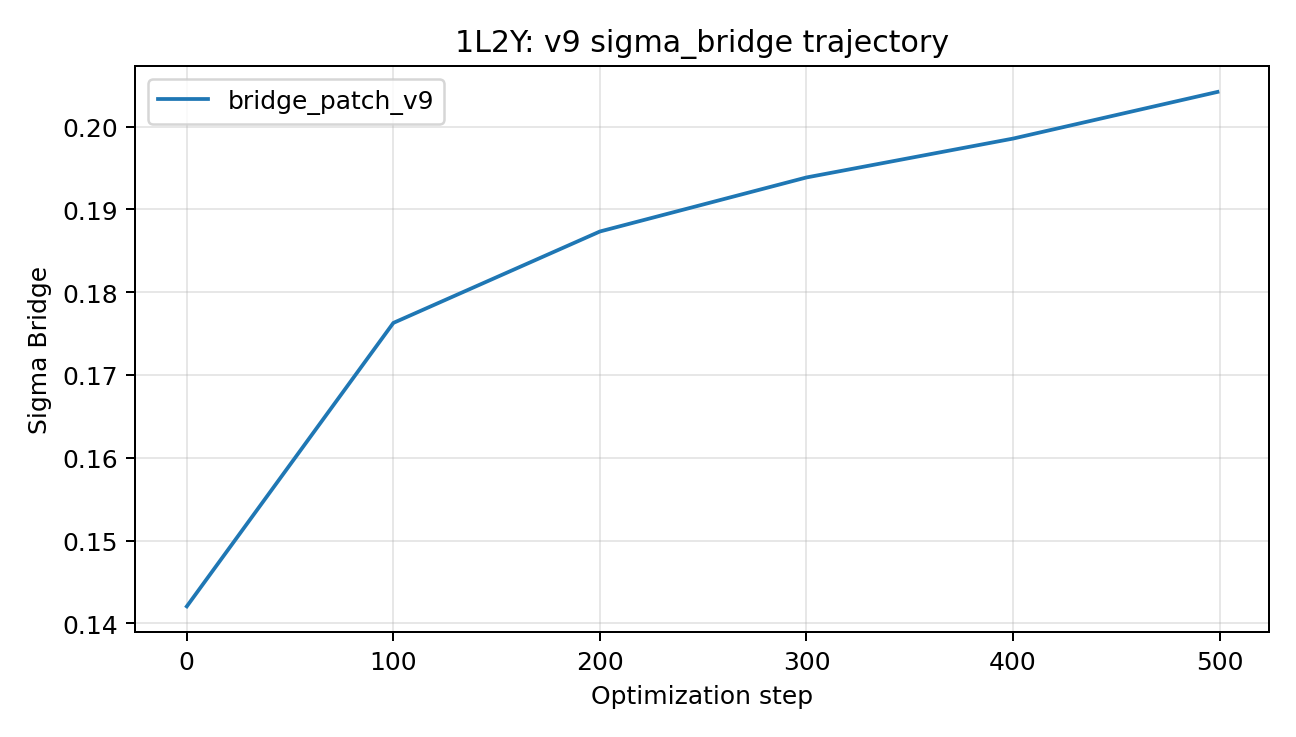
1L2Y sigma_bridge over step. The trajectory packet’s question: does the bridge observable move with structural ordering, or only appear in the summary CSV?
uqcf_bridge_v9_trajectory_packet_bundle

What the 12 Apr posts claim, and refuse
- Claimed: backbone ordering improved; angle regularity improved; RMSD moved in the right direction across 1UAO and 1L2Y; v9 is the first patch that looks cross-target viable.
- Refused in the same posts: full folding solved; robust long-range contact closure; proof of the entire ToE.
- Open in the memo: pooled frozen confirmation across both targets; contact recovery still inconsistent; RMSD not decisively significant.
- Two days later the Villin HP35 R_t post asks a related question (identical snapshot, different fate). Do not collapse v9 RMSD traces onto the Villin AUC number — different harness.
If a ToE is real, it should do more than compress known physics. It should generate a new, testable organizing principle in a domain it was never built for.
Restricted
On the posted 1UAO and 1L2Y traces, frozen bridge-patch v9 improved backbone / angle ordering and moved RMSD in the right direction versus baseline. This is a pre-classical ordering effect in a small-protein harness. It is not native folding, not contact closure, and not a TOE confirmation.
- v9 update bundle
- v9 trajectory packet
- 12 Apr X post (bounded claim)
- Trajectory packet on X
- Villin HP35 (two days later)
X sources
Original posts this article was compiled from. The notebook copy is editorial; the status URL is the source.
-
2026-04-12
Frozen v9 protein bridge on 1UAO / 1L2Y
-
2026-04-14
Villin HP35: identical snapshot, different fate
Previous p53 mutational mechanismsNext TSP coherence backbone
Causal stack
- 00 Astra / global consistency
- 01 Genesis Pin
- 02 Retained pruning-order history
- 03 Admissible slice
- 04 L1 (closed)
- 05 L2 (closed)
- 06 L3 hyperedge memory T_H + D_L3
- 07 L4 H₄ rank lift
- 08 Discrete atlas / scalar accessibility
- 09 GEM-bridge / gravity
On this page
Related articles
- For researchers and models
- Claim ledger
- Recoverability geometry
- Applied recoverability stack
- TSP coherence backbone
- WetLabEngine protein audit
- p53 mutational mechanisms
- MECP2 Rett MBD–DNA campaign
- X science notebook
GitHub packages
Field notes
-
Frozen v9 protein bridge on 1UAO / 1L2Y
2026-04-12
-
Villin HP35: identical snapshot, different fate
2026-04-14