v12.41 moment-map closure
Qubit Kirillov–Kostant–Souriau identity: quantum relations → symplectic generators → closed constraint algebra. 121-step public simulation. Restricted finite calc. Gravity’s constraints not identified.
00 Astra · Result · Restricted · 2026-09-10 · compiled 2026-10-10 · 3 min read · 2 claims · 5 X sources
Original on X · Package: UQCF_GEM_v12_41_PUBLIC_SIMULATION_COMPLETE · JSON · Cite
Astra · v12.41 · constraint algebra · symplectic · moment map
On this page
- The posted chain
- What the 121-step run actually shows
- Run this first
- The week that led here (7–9 Sep)
Causal stack
- 00 Astra / global consistency
- 01 Genesis Pin
- 02 Retained pruning-order history
- 03 Admissible slice
- 04 L1 (closed)
- 05 L2 (closed)
- 06 L3 hyperedge memory T_H + D_L3
- 07 L4 H₄ rank lift
- 08 Discrete atlas / scalar accessibility
- 09 GEM-bridge / gravity
Posted 10 Sep 2026 20:25 UTC with a five-second film. GitHub packet Tmp/TOE/UQCF_GEM_v12_41_PUBLIC_SIMULATION_COMPLETE landed eight minutes earlier (commit v12_41). ChatGPT-5.6 Astra derived the chain; the public simulation is a qubit density matrix swept through 121 ordered unitary relational transforms. This compile independently reconstructed the core: max exact residual 0, max broken residual 0.297. Not Einstein constraints. Not ADM. λ is an index, not physical time.
This is not a claim that Astra derived gravity. Gravity’s constraints have not been identified yet. But we no longer have to assume that a constraint algebra must begin with spacetime.
The posted chain
On Pauli generators the last line is the su(2) moment-map identity {C_x, C_y} = 2 C_z, because −i[σ_x, σ_y] = 2 σ_z. The public script checks that identity on a mixed qubit seed conjugated by U_z(0.55λ) U_y(0.35λ) U_x(0.20λ) at 121 values of λ ∈ [0, 2π].
Restricted
Posted public simulation: Bloch / moment-map coordinates, C_A traces, exact residual vs deliberately broken generator law. Ordered relational sweep — not a gravitational orbit.
v1241_public_simulation.mp4 · GitHub packet
What the 121-step run actually shows
| Quantity | Posted log | This compile |
|---|---|---|
| steps | 121 | 121 |
| max exact Δ_closure | 0 | 0 |
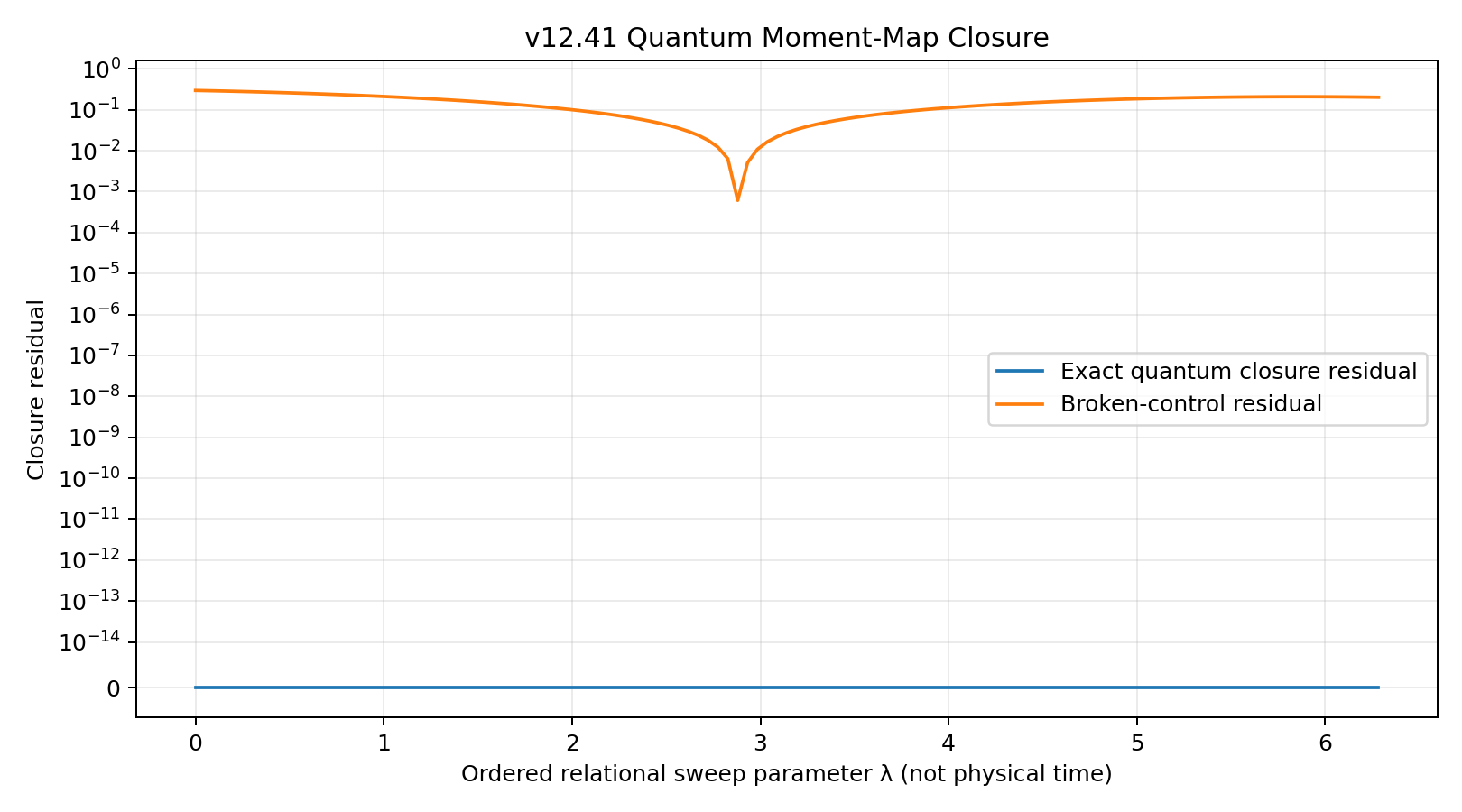
| max broken Δ_closure | 0.297 | 0.297 |
| min density eigenvalue | 0.2508 | 0.2508 |
| purity (constant) | 0.6242 | 0.6242 |
Broken control is 1.25 C_z + 0.15 C_x in place of 2 C_z. Exact residual stays at machine zero; the broken law does not. Independent reconstruction used the posted seed, not the author’s Python import.
Live reconstruction on this page
The canvas below the article is a browser rebuild of the same Pauli core. It is a teaching toy. The posted MP4, PNG, and CSV remain the artifacts. This compile independently reconstructed max exact residual 0 and max broken residual 0.297.
Restricted
Posted verification plot. Vertical axis is closure residual on a symlog scale. Exact branch is the quantum generator law; broken branch contaminates the structure coefficients.
v1241_public_simulation_verification.png · GitHub packet

Restricted
On the posted 121-step qubit sweep, the KKS / Pauli moment-map identity closes with Δ_closure = 0. Deliberately breaking the generator law yields Δ_closure > 0 (max 0.297). Finite quantum construction. Not a derivation of gravity, ADM, or Einstein constraints.
Run this first
Clone the public packet
git clone --depth 1 https://github.com/proteinfoldingengine/WetLabEngine.git
cd WetLabEngine/Tmp/TOE/UQCF_GEM_v12_41_PUBLIC_SIMULATION_COMPLETE
python test_uqcf_v1241_public_sim.py
python uqcf_v1241_public_sim.py
uqcf_v1241_public_sim.py — exact vs broken residual
def exact_closure_residual(rho):
    sx, sy, sz = paulis()
    lhs = kks_bracket(rho, sx, sy)          # -i Tr(ρ [σx, σy])
    rhs = 2.0 * moment_map(rho, sz)         # C_{-i[σx,σy]} = 2 C_z
    return abs(lhs - rhs)

def broken_closure_residual(rho):
    sx, sy, sz = paulis()
    lhs = kks_bracket(rho, sx, sy)
    rhs = 1.25 * moment_map(rho, sz) + 0.15 * moment_map(rho, sx)
    return abs(lhs - rhs)
What a successful run does not show
It does not identify the gravitational constraint algebra. It does not introduce ADM, Einstein equations, or fundamental time. The sweep parameter λ is an ordered family of relational transformations. The broken control is an internal null, not a physical perturbation.
The week that led here (7–9 Sep)
v12.41 is the simulation. The three Astra posts immediately before it stay on X (no matching GitHub packet in this compile). They are the questions the simulation does not close.
- 7 Sep — UQCF–GEM v9.190: exact reconstruction of the affine map γ(x) = u + Lx from eleven source settings (110 real coefficients) on a nonsingular domain. Distinguishes γ(x) = g x from offsets, unequal gains, and cross-coupling. Exact model numerics. Physical source law open.
- 8 Sep — conditional principle: each matter sector already has K_α = g_α n J_α(t_α). Quantum consistency does not force g_1 = g_2 = ⋯. One signed source coefficient before sector specialization, K_α^U = g_★ n J_α(t_α) ∀α, is the unique protected-source response that survives erasure of matter-sector labels. Author: not yet a derivation of gravity.
- 9 Sep — N-cycle difference operator: σ_min^+(D_N) = 2 sin(π/N). Bare inverse ~ N/(2π); after geometry supplies h = 1/N the inverse converges to 1/(2π). No fitted force law. Gravity connection still open.
Open
The gravitational constraint algebra has not been identified. v12.41 shows a constraint algebra can start from quantum relations on a qubit. Mapping that algebra onto g_★, the D_N continuum seed, or Einstein/ADM remains open.
- X post (10 Sep, video)
- GitHub public simulation packet
- Vendored Python
- Diagnostics CSV
- Astra identities (F, t*, d(t))
- Quantum compatibility lab (v9.167 / v9.190)
- Emergent gravity (still a candidate)
Live reconstruction
Restricted
121-step moment-map closure
Same qubit seed and generator law as the posted GitHub script. Exact residual must stay at 0; the broken control must not. This canvas is a teaching toy — the posted MP4 and CSV remain the artifacts.
step 120/120 · Δ_exact 0.0e+0 · Δ_broken 0.203 · this compile max exact 0.0e+0 · max broken 0.297
X sources
Original posts this article was compiled from. The notebook copy is editorial; the status URL is the source.
-
2026-09-10
v12.41 moment-map closure — constraint algebra without spacetime
-
2026-09-09
N-cycle inverse converges after geometry-supplied scale
-
2026-09-08
Universal source coefficient g_★ before sector specialization
-
2026-09-07
UQCF–GEM v9.190 affine source reconstruction
-
2026-09-06
Same response ≠ same quantum reality
Previous Astra (pre–Genesis Pin)Next Compatibility lab
Causal stack
- 00 Astra / global consistency
- 01 Genesis Pin
- 02 Retained pruning-order history
- 03 Admissible slice
- 04 L1 (closed)
- 05 L2 (closed)
- 06 L3 hyperedge memory T_H + D_L3
- 07 L4 H₄ rank lift
- 08 Discrete atlas / scalar accessibility
- 09 GEM-bridge / gravity
On this page
- The posted chain
- What the 121-step run actually shows
- Run this first
- The week that led here (7–9 Sep)
Related articles
- Claim ledger
- Quantum information
- Astra (pre–Genesis Pin)
- Quantum compatibility lab (v9.167)
- Emergent gravity (candidate)
- Package 17 — derivation program
- Proofs, simulations, and figures
GitHub packages
Field notes
-
v12.41 moment-map closure — constraint algebra without spacetime
2026-09-10
-
N-cycle inverse converges after geometry-supplied scale
2026-09-09
-
Universal source coefficient g_★ before sector specialization
2026-09-08
-
UQCF–GEM v9.190 affine source reconstruction
2026-09-07
-
Same response ≠ same quantum reality
2026-09-06