Battery recoverability (V720–V724)
NASA PCoE LCO relaxation trajectories: active restoration-deficit beats passive snap distance — an applied recoverability assay.
Applied · Applied · Restricted · 2026-05-19 · compiled 2026-10-10 · 1 min read · 1 claim · 1 X source
Original on X · Package: battery · JSON · Cite
battery · NASA · V720 · applied
Causal stack
- 00 Astra / global consistency
- 01 Genesis Pin
- 02 Retained pruning-order history
- 03 Admissible slice
- 04 L1 (closed)
- 05 L2 (closed)
- 06 L3 hyperedge memory T_H + D_L3
- 07 L4 H₄ rank lift
- 08 Discrete atlas / scalar accessibility
- 09 GEM-bridge / gravity
The retained-atlas framework was pressure-tested on the NASA PCoE LCO battery dataset (V720) and on synthetic assays V723/V724. Passive “snap distance” (instantaneous voltage drop) delivers AUC 0.6366 and is already collapsing toward chance. Integrated restoration-deficit metrics — early_auc, tail_auc, full_auc — reach AUC 0.9326 and Spearman 0.8715 to capacity loss. Residualizing out the initial snap still leaves AUC 0.8655.
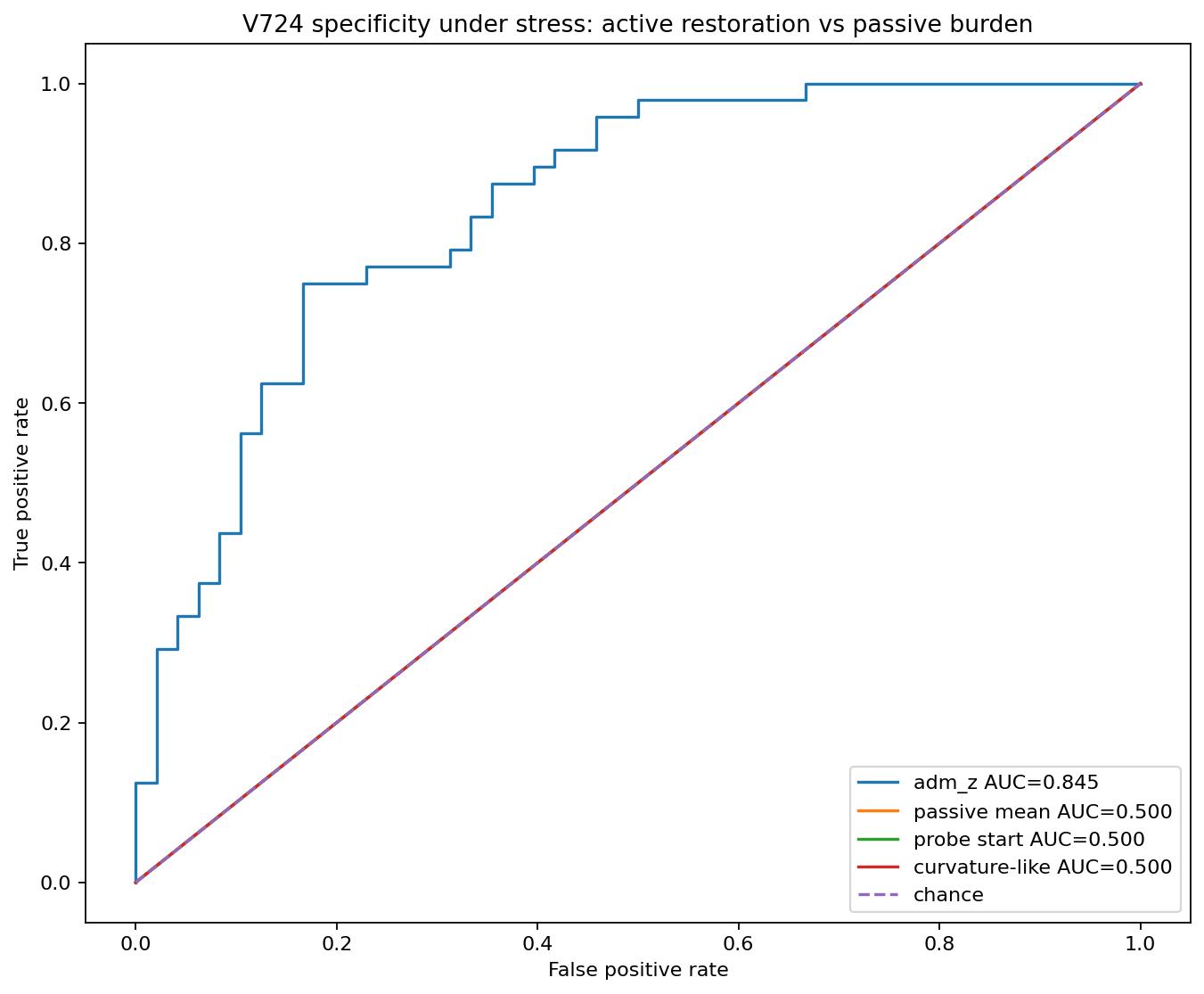
V723 holds passive burden metrics at chance (~0.500) while active adm_z separates perfectly (AUC 1.000) in the synthetic. V724 adds overlapping k, nonlinear saturation, reserve fatigue, stochastic stalls, and shortened windows; signal holds at ≈0.845. Geometry-like structures (curvature concentration, geodesic relaxation, stress localization) are reported as emergent in the assay, not imposed.
Supported
V724 stress-test ROC: active restoration-deficit (adm_z) versus passive snap. Signal holds under overlapping k, saturation, fatigue, and shortened windows. Applied recoverability, not a field equation.
v724_stress_test_outputs on GitHub
Supported
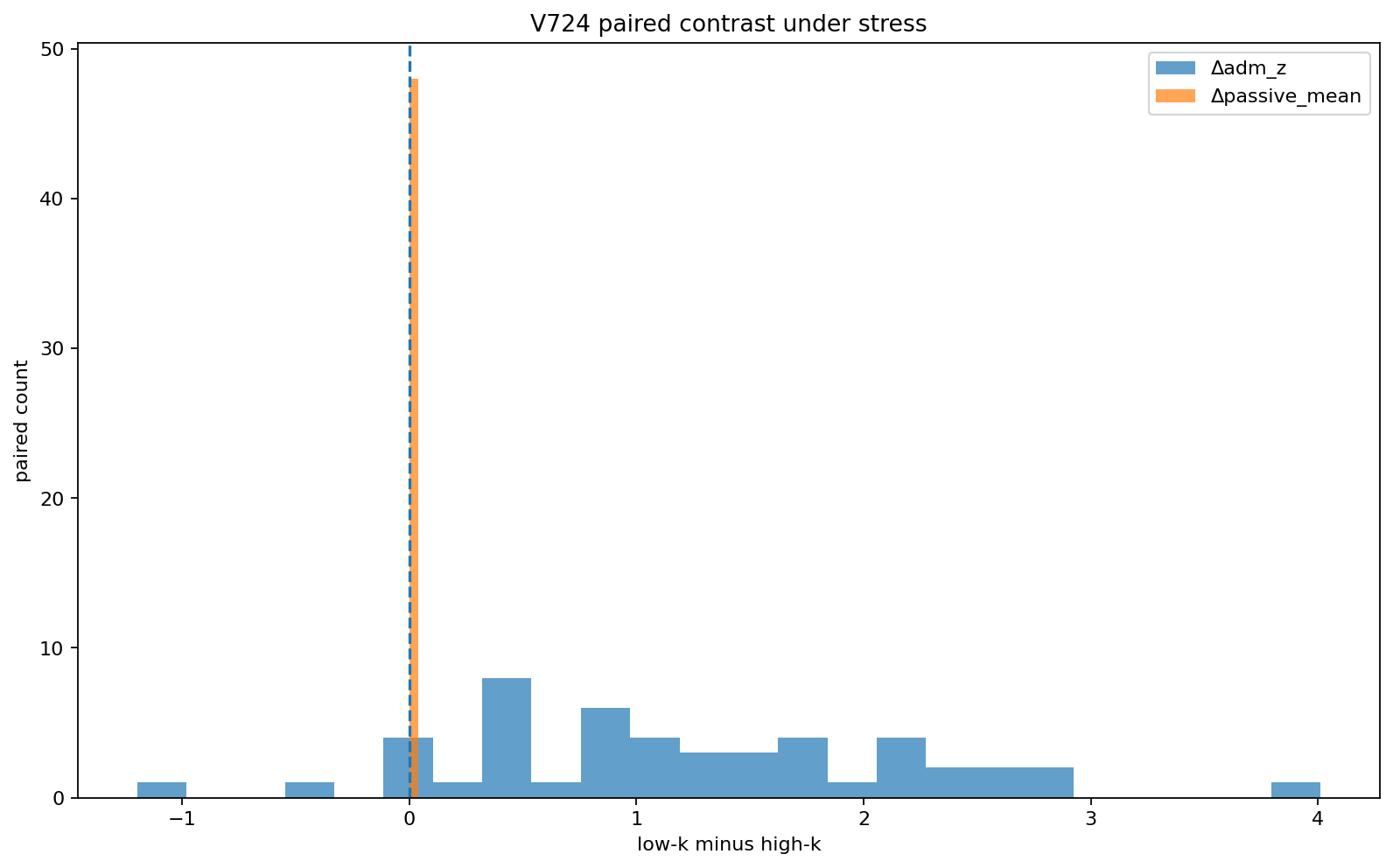
Paired Δ(adm_z) versus passive on the same synthetic trajectories. The passive metric collapses toward chance.
v724_stress_test_outputs on GitHub

Supported
On this public NASA dataset and the published synthetics, active restoration-deficit scoring outperforms passive snap. This is an applied recoverability result. It does not solve battery aging and does not derive field equations.
A 18 May 2026 open letter (posted from the account, attributed as a Grok draft) argued Tesla already collects the relevant rest-window voltages in BMS health checks. That is advocacy built on the assay, not a Tesla collaboration claim. The original V723/V724 assay video is 18 May: passive burden held equivalent, active perturbation-response still showing restorative structure — observation only, synthetic, falsifiable.
X sources
Original posts this article was compiled from. The notebook copy is editorial; the status URL is the source.
-
2026-05-19
NASA battery assay and Tesla letter
Previous C3++ Stability GovernorNext May 2026 ladder
Causal stack
- 00 Astra / global consistency
- 01 Genesis Pin
- 02 Retained pruning-order history
- 03 Admissible slice
- 04 L1 (closed)
- 05 L2 (closed)
- 06 L3 hyperedge memory T_H + D_L3
- 07 L4 H₄ rank lift
- 08 Discrete atlas / scalar accessibility
- 09 GEM-bridge / gravity
Related articles
- Recoverability geometry
- Restricted bridge theorems
- Applied recoverability stack
- C3++ Stability Governor
- Proofs, simulations, and figures
GitHub packages
Field notes
-
NASA battery assay and Tesla letter
2026-05-19