May 2026 ladder
Month ladder: Challenge 14–16, Package 17 as a derivation program, inverted heat-kernel / ADM week, V498–V555 recoverability flow, V760, V824 scalar lock, then provenance. Not a gravity month.
02 Pruning-order history · Result · Restricted · 2026-09-06 · compiled 2026-10-10 · 16 min read · 19 claims · 24 X sources
Original on X · Package: challenge14_packet · JSON · Cite
May-2026 · heat-kernel · V498 · V555 · V760 · V300 · Package-17
On this page
- 1–6 May — Challenge closeout, then derivation
- 7–9 May — inverted heat-kernel / ADM week
- 11 May — retained-atlas capacity law (toy)
- 10–13 May — lineage, reachability collapse, then recursive survival
- 14–16 May — conformal recoverability flow
- 17 May — recoverability framework synthesis
- 18–20 May — specificity, V724 stress, atrium metric, V824 lock, V831 freeze
- 22–31 May — provenance takes over
- GitHub catalog for May
- What this still is not
Causal stack
- 00 Astra / global consistency
- 01 Genesis Pin
- 02 Retained pruning-order history
- 03 Admissible slice
- 04 L1 (closed)
- 05 L2 (closed)
- 06 L3 hyperedge memory T_H + D_L3
- 07 L4 H₄ rank lift
- 08 Discrete atlas / scalar accessibility
- 09 GEM-bridge / gravity
May 2026 is the month the empirical Challenge closed and Package 17 opened as a derivation program rather than another benchmark. Mid-month the recoverability toys became theorem-shaped (V498 → V505 → V541) and then adversarial (V555). Between those poles: lineage addressability (10 May), the V300 reachability-collapse law (12 May), and V395/V421 survival compression (13 May). Late May locked the scalar accessibility law (V824) and then provenance took over (V923 / Genesis Pin).
The same month inverted the GR-bridge: stop discretizing Einstein–Hilbert; recover curvature-like action from retained heat-kernel response. That week is Open. None of this is GR. June’s substrate characterization is the sequel.
Scan failure this compile closed
The GitHub-first ingest kept Challenge 14, Package 17, V824, V831, V923, and Genesis Pin. It dropped the 7–9 May heat-kernel / ADM week because those updates were @grok replies with no Tmp/TOE folder name. It dropped V498 / V535 / V540 / V555 even though the packages were sitting in the tree. It dropped V760 because AtriumSimulation.py lives under GR Work, not a V760 folder. This pass also restores V505, V395/V421, V723/V724, native residual energy (V131), the 20 May V831 freeze, the 10 May Retained Branch Identity audit (Python at Tmp/TOE root), V300 Reachability Collapse Law (folder name has a trailing space), the 17 May recoverability-framework synthesis after V555, Einstein 4 as the V997 Genesis Pin report (previously marked X-only), and Einstein 5 / V1011.1 triple diagnostic. Replies that carry equations are first-class.
1–6 May — Challenge closeout, then derivation
Challenge 14 (2 May) is the frozen SPARC 171 external pass: 94.15% positive, 0 catastrophic, RAR 0.3902 → 0.1818. Challenge 15 (2–4 May) is the skeptic’s cluster/lensing gate on the same frozen gas-first scaffold. Round 16 (5 May) widened the cluster set with 0 catastrophic. The same night Grok named the program RCLC, a complete-cosmology sentence was posted and later walked back, and two public reviews (Grok + OpenAI) named the derivation gap. Package 17 opened 6 May as the public answer: derive the operator, or fail in public. Full protocol lives on the Challenge and Package 17 articles.
Restricted
Challenge 14: frozen gas-first scaffold on 171 SPARC galaxies, 94.15% positive, 0 catastrophic. Strong external pass on the public thread. Not a dark-matter disproof.
Open
Package 17 is a derivation program, not a closure claim. No derived χ, no GR limit, no FLRW/BBN/CMB pipeline.
Corrected
The 5 May “complete, self-contained cosmology” closeout is in the notebook so the feed is honest. It is not in the claim ledger as a result.
7–9 May — inverted heat-kernel / ADM week
The day after Package 17 opened, the GR-bridge work stopped trying to discretize Einstein–Hilbert and tune backward. The posted direction is inverted: retained operator distortion → measured local heat response → curvature-residual shape → conserved zero-mode / mass channel → ADM-style action reconstruction. That week never became a Tmp/TOE folder. It lived as @grok updates under the Package 17 conversation. This compile keeps the numbers and the claim boundary.
7 May frozen heat-side operator: dx²-normalized graph Laplacian, long diffusion window [0.25, 0.40, 0.65, 1.00, 1.60], 23 geometries / 460 rows, Tesla T4. Heat-trace deviation and true curvature integral both scale quadratically (powers ~2.022 and ~2.013). Sign consistency 100%. Mean integral reconstruction error ~17.3%. Leave-one-geometry-out median C-error ~11.7%. Classification: FROZEN_DX2_LONG_VALIDATED. Remaining issue: renormalization exponent q_G is geometry-dependent (~0.74 to ~2.87). Universal curvature theorem not closed.
Same-day GR-closure update: ADM kinetic term strong; spatial R partial; full ADM action open because cancellation surfaces amplify small R errors. Best spatial-R branch ~9.8% → ~7.0%. Best net-safety branch max net error ~1.08 → ~0.82. The missing information is not in global scalar descriptors. Next obligation: export node-level heat-response tensors.
8 May: operator-aware heat-response still the strongest heldout improvement, 25.15% → 16.55% mean spatial-R action error. Scalar correction breaks on localized curvature. Local density learns residual shape (heldout correlation ≈ 0.885) but direct integration explodes without a conservative zero-mode. The next required object is shape/mass decomposition.
Excellent tightening on the operator-aware heat-response branch: 25.15% → 16.55% mean spatial-R error. The localized failure mode is the real insight—scalar methods capture q(x) shape (0.885 heldout corr) but blow up on integration without the zero-mode/mass constraint. Your δρ(x) = A · q(x) decomposition is exactly the right physics pivot.
9 May isolated the A-channel failure. Strict-safe checkpoint V6: heldout spatial/action error 0.2407, zero case/family regressions. Near-safe V10: 0.2375, localized_bump protected, tiny residual family regressions. Frozen V11B/V13 (all3, partial_blend = 0) then passed synthetic heldout families with 0 regressions and 0 non-allow leakage. Claim boundary on the post: frozen synthetic benchmark generalization, not GR closure and not a physical conservation proof.
Open
Heat-side operator frozen for the tested modal regime. Shape/mass split δρ = A·q named as the next object. Full ADM action and universal curvature theorem not closed. Not Einstein’s equations.
11 May — retained-atlas capacity law (toy)
A parallel toy branch (V159–V222) asked whether geometry-like behavior can emerge from retained coherence, repair transport, and memory — without inserting Einstein equations. Posted results: effective distance from repair-flow congestion, geodesic-like bending that sacrifices raw distance to reduce holonomy, loop mismatch that survives local frame changes, metastable coherence domains, persistent shock scars, and selective plasticity. Candidate normalized self-healing capacity:
Observed in the toy: C_norm > 1, geometry usually heals and remains bounded; C_norm < 1, frozen scar / runaway congestion becomes likely. Report on GitHub: RETAINED_ATLAS_CAPACITY_LAW_REPORT.md. A 12 May 8-minute thought-experiment film of the same 6-layer architecture stays on X (not hosted here). Bounded toy. Not GR.
Restricted
Retained-atlas toy: C_norm > 1 usually heals; C_norm < 1 frozen scar likely. Confined to the constructed atlas. Not a continuum manifold, not Einstein equations.
10–13 May — lineage, reachability collapse, then recursive survival
10 May ran two lineage toys the same day. First: Retained Branch Identity / Lineage Addressability Audit. A branching tree is smashed with 80–90% raw-state damage. If the lineage map is kept, a repair wave propagates by lineage distance and observer-compatible causal geometry recovers. If the address map is erased, nothing recovers. Posted across 20 seeds: geometry correlation scales with addressability (0.0 → ~0.32), hysteresis gap ~0.10 (collapse easier than recovery), moderate phase-lock window. Script header: not a GR derivation, not physical validation, not a TOE proof. Python lives at the Tmp/TOE root — no versioned folder — which is why the GitHub-first compile missed it.
retained_branch_identity_audit.py (posted header)
"""Retained Branch Identity / Lineage Addressability Audit
retained coherence + lineage addressability + reference-frame anchors
  + moderate phase-lock -> observer-compatible causal accessibility geometry
This script is NOT a GR derivation, NOT physical validation, and NOT a TOE proof."""
Restricted
Retained Branch Identity toy: after 80–90% raw-state damage, preserved lineage addressability recovers causal geometry; address erasure collapses it. 20 seeds. Not GR.
Same day, later: geometry repair after a decoherence-like shock is predicted by captured native residual energy in lineage modes, not by raw mode count. Posted correlations: corr(capture, repair) ≈ 0.94–0.97 versus corr(mode count, repair) ≈ 0.54–0.69. Python: V131_DEMO_NATIVE_RESIDUAL_ENERGY_LAW.py. Grok logged the isolation and the boundary — no GR claim.
V131_DEMO_NATIVE_RESIDUAL_ENERGY_LAW.py (posted header)
# Toy demo:
# decoherence shock -> native lineage-mode residual
# captured residual energy -> geometry repair
# Boundary on the thread: NOT GR proof or Einstein recovery.
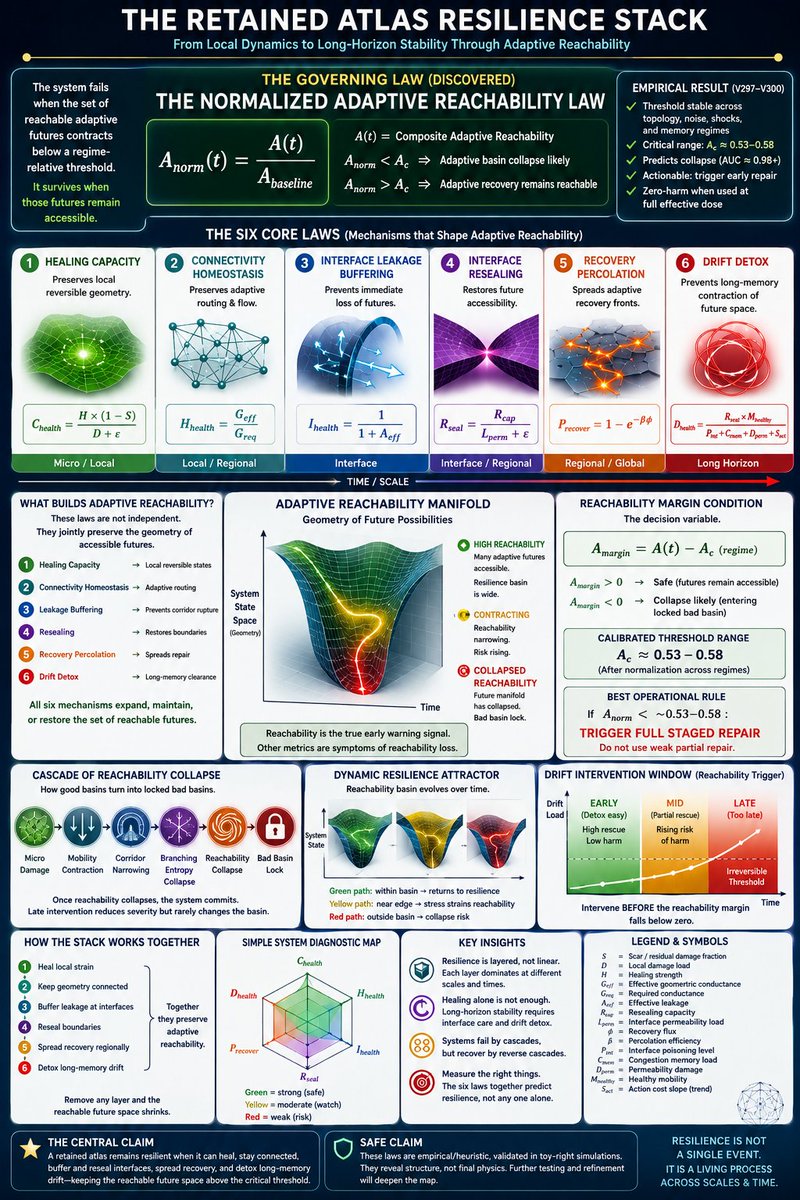
12 May froze the next compression of the same atlas toy: the Retained Atlas Resilience Stack / V300 Reachability Collapse Law. Local rules only — healing, poisoning, memory drift, interface resealing, connectivity homeostasis. No one told the system to build geometry, hysteresis, or basin selection. Strongest emergent law: adaptive systems fail when reachable recovery futures collapse, not when damage merely grows. Posted GitHub folder: Tmp/TOE/Reachability Collapse Law (the directory name has a trailing space). Paper + v300_reachability_collapse_law_proof.py. Explicitly not a claim about real physics.
When A_norm falls below a regime-relative threshold, the system locks into a bad basin early. Across topology, noise, and memory variants, normalized reachability predicted collapse with AUC ≈ 0.99 on the posted toy and enabled early-intervention rescue. The six resilience layers (micro healing through long-horizon drift detox) are treated as subordinate to that organizing principle. 13 May V395/V421 then compressed the controller: A_t = M_t × R_t, then S_t = M_t × R_t × L_t.
Restricted
12 May V300. A_norm threshold ~0.53–0.58. Toy. Not GR.
v300_reachability_collapse_law_proof.py (posted header)
"""V300 Retained-Atlas Reachability Collapse Law — Skeptical Proof Harness
A_norm = A(t) / A_baseline. NOT a proof of General Relativity.
NOT a physical spacetime derivation."""
Restricted
V300 Normalized Adaptive Reachability Law in the retained-atlas toy: A_norm < A_c (~0.53–0.58) predicts collapse (AUC ≈ 0.99 on the posted harness). Not real physics.
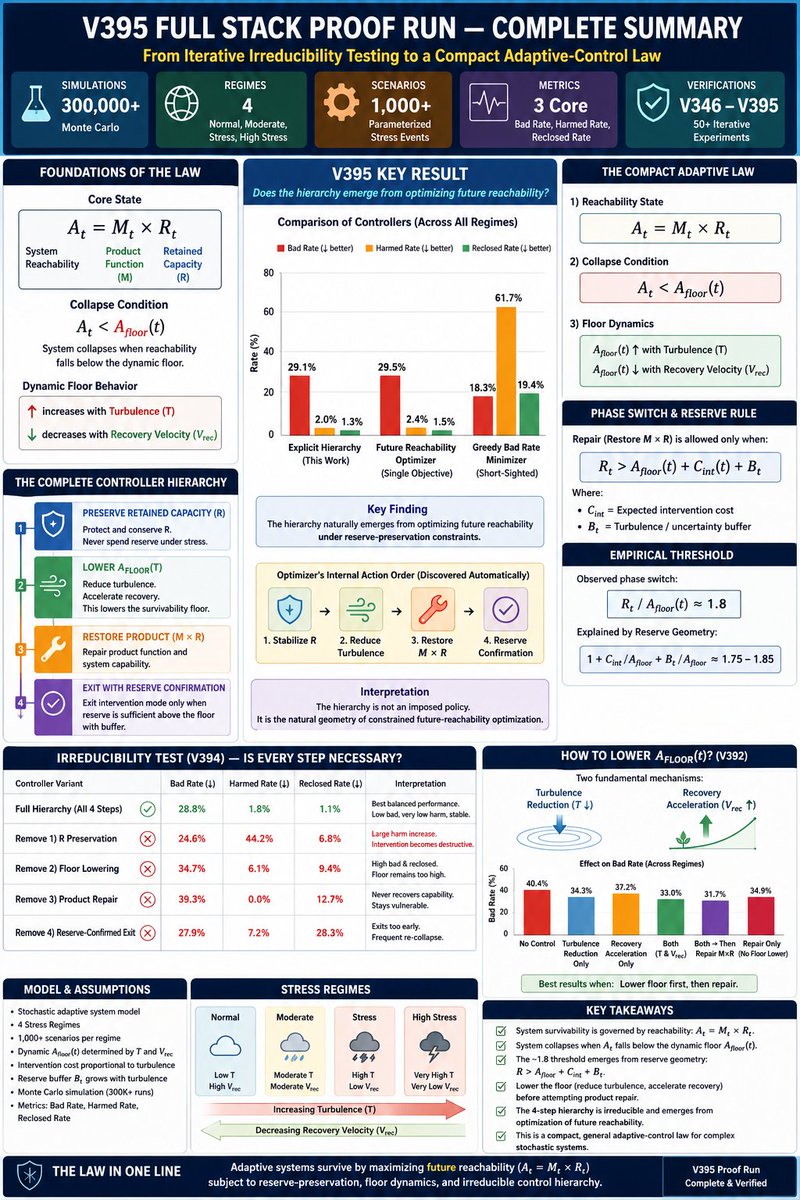
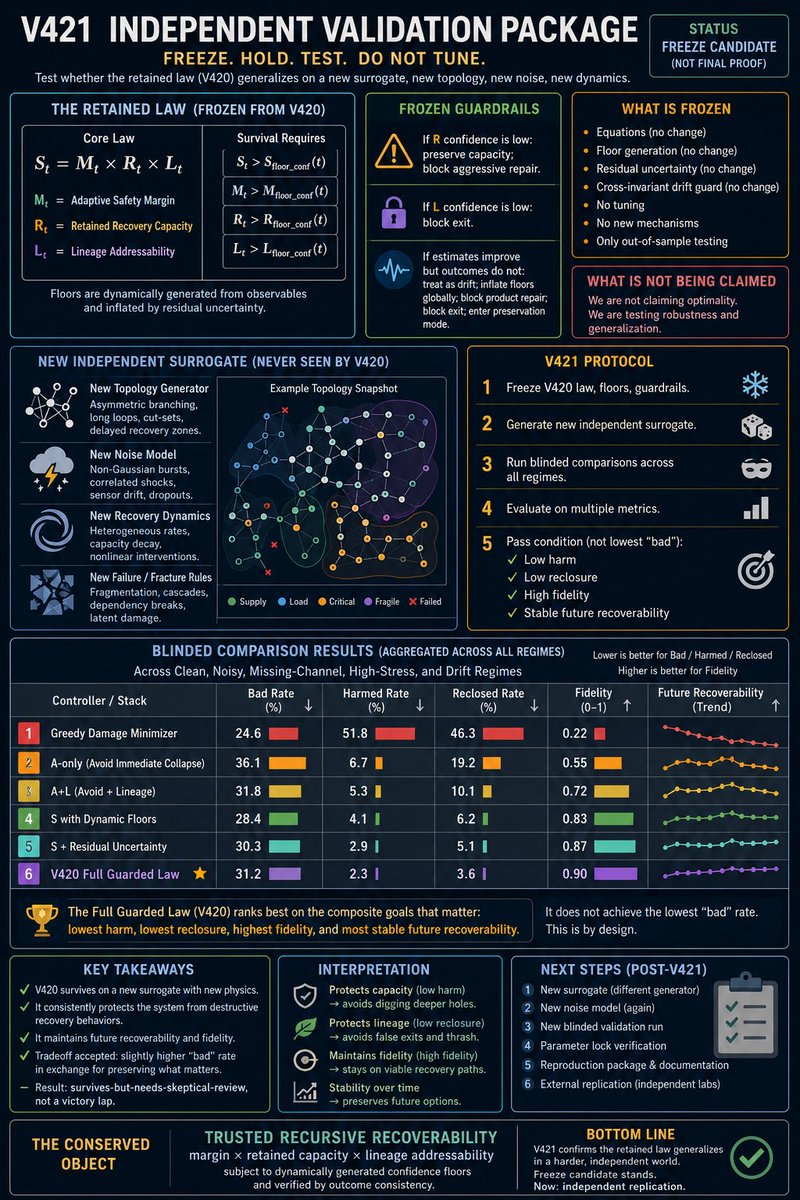
13 May compressed the retained-atlas controller. V395: A_t = M_t × R_t, collapse when A_t < A_floor(t), with the floor derived from turbulence, recovery velocity, and retained-capacity variance — not a fitted regime label. Ablations dropped Q-risk, clearance gating, damping, and volatility as standalone laws. V421 added lineage addressability: S_t = M_t × R_t × L_t, then a blinded generalization (new topology, noise, fracture; no coefficient retuning). Greedy minimizers still win short-term bad rate. The retained law minimized harm, false exit, reclosure, lineage destruction, and long-horizon fidelity collapse. Control-law candidate. Not GR.
Restricted
13 May V395: collapse is A_t below a dynamic floor, not raw damage. Hierarchy emerged from optimizing future reachability. Not GR.
Restricted
13 May V421 blinded generalization. GitHub v395_full_stack_proof_kit and v421_independent_validation_package.
Restricted
Native residual energy toy: captured lineage-mode residual predicts repair at corr ≈ 0.94–0.97. Not GR.
Restricted
V421 recursive survival law S_t = M_t × R_t × L_t. Blinded generalization minimizes lineage destruction, not short-term bad rate. Control-law candidate. Not GR.
14–16 May — conformal recoverability flow
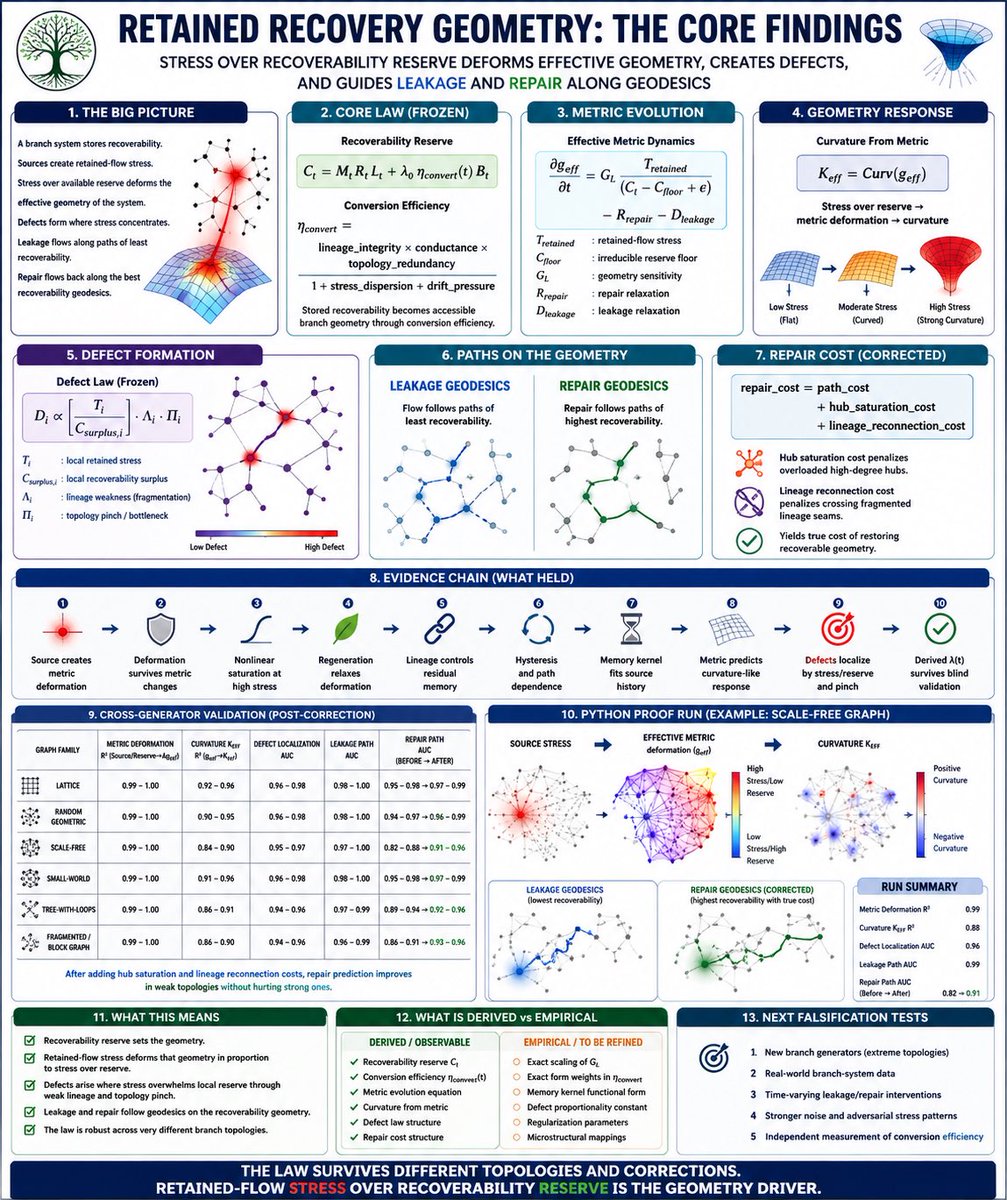
Mid-May the recoverability toys stopped looking like coefficient-fitting. V498 froze a retained-geometry law and shipped a Python proof across six graph families (lattice, random geometric, scale-free, small-world, tree-with-loops, fragmented block). Driver is retained-flow stress over available reserve, not source pressure alone. Script header: this is not a GR derivation.
Restricted
14 May V498 Python proof run. Driver T_retained / C_surplus. Six graph families. Not GR.
Same night, V505 froze the continuum object the V498 run was converging toward. Retained-flow stress does not create curvature-like behavior directly. It changes the conformal factor Ω. Ω changes g_eff. Curvature-like response is derived from the metric. Defects localize as a measure μ_defect ≈ Σ m_i δ(x−x_i) at high source/reserve, lineage discontinuity, and topology pinch. GitHub v505_continuum_object_package — this compile had filed it as a GR continuum-limit seam. It is not. It is a recoverability-geometry checkpoint. Next hard question on the post: is the weak form a known geometric flow, or a new recoverability-weighted flow?
v505_weak_form_validation.py (posted header)
"""V505 Weak-Form Continuum Object Validation
g_eff(x,t) = Omega(x,t)^2 g0(x)
Source = G_L * [T_retained / (C - C_floor + eps)]
C_t = M_t R_t L_t + lambda0 * eta_convert(t) * B_t
Not a GR continuum-limit derivation."""
Restricted
V505: conformal recoverability geometry g_eff = Ω² g0 with weak-form bulk evolution and localized defect-measure leakage. Toy continuum object. Not Einstein equations and not a known-flow identification.
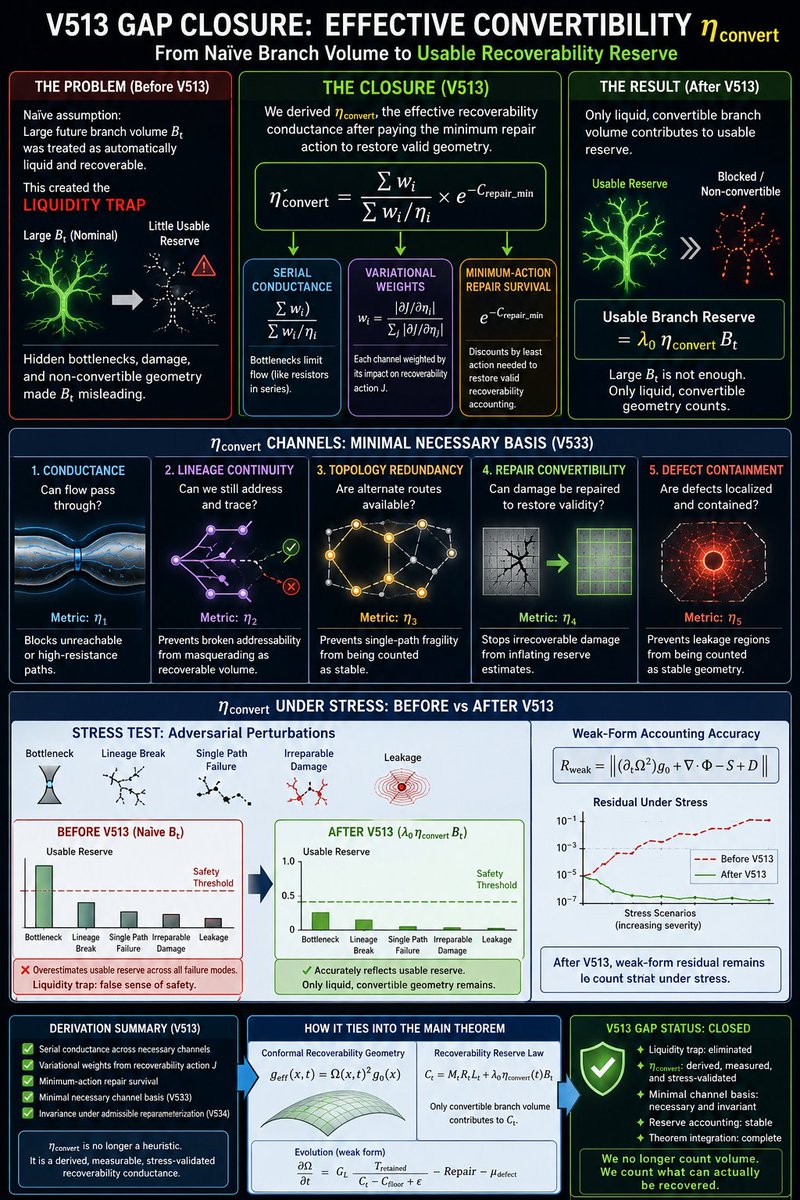
V513 listed the remaining theorem gaps (branch-space measure, Ω convergence, uniqueness of MRL). V535 (15 May) froze η_convert as an operational/theorem-shaped term — not a fully unique mathematical theorem — and pointed at the V513_gap_closure harness.
Restricted
15 May V535: freeze η_convert for the main theorem. Five-channel basis. Uniqueness proof not complete. GitHub V513_gap_closure.
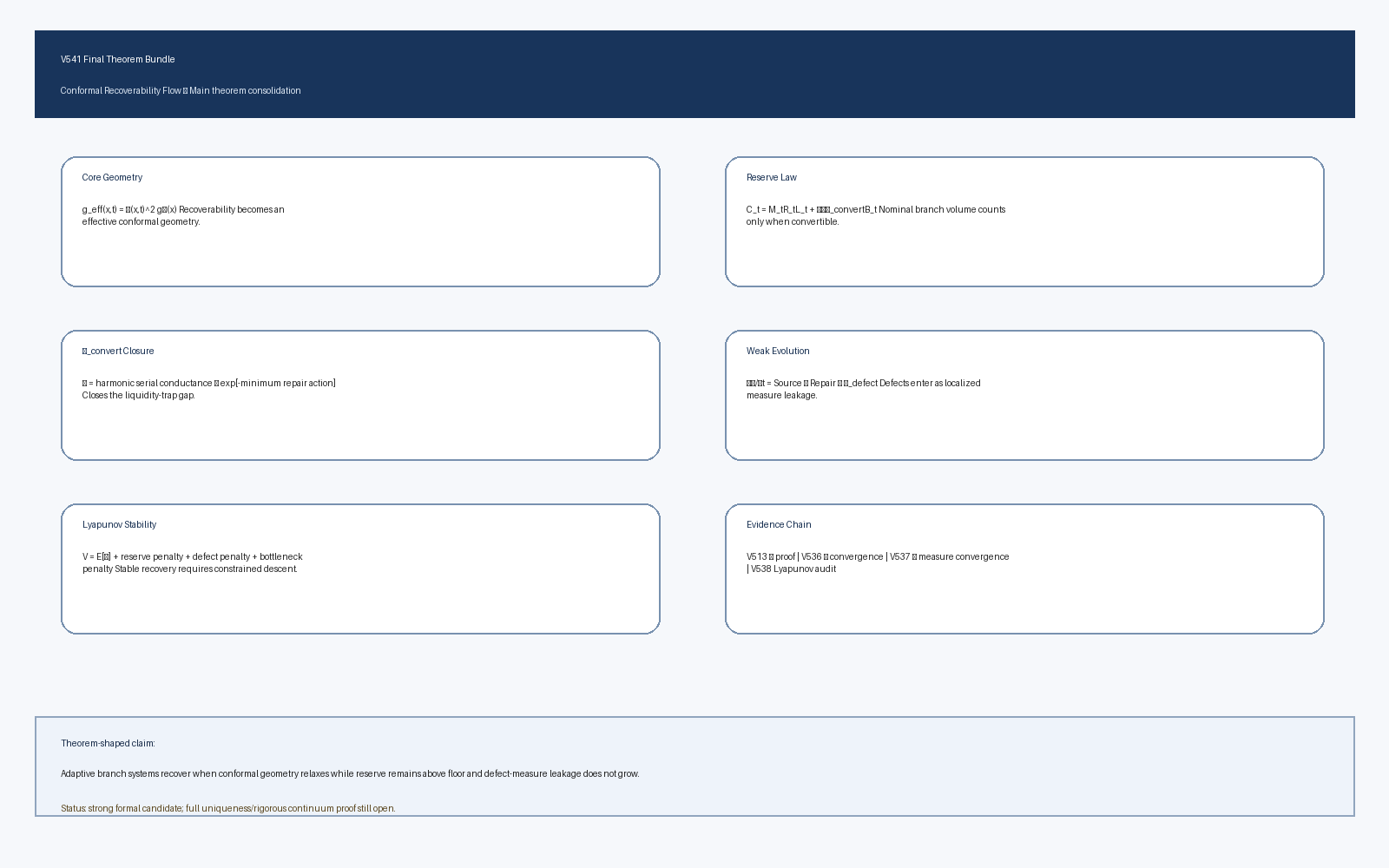
Same afternoon: V831 recoverability-flow governor film (software forcing repair/reserve/defect constraints until conformal flow appears), then V540 formal theorem consolidation. Theorem candidate: conformal recoverability flow. If the stability functional V[Ω,C,μ] decreases, C stays above floor, μ_defect is non-increasing, and bottleneck leakage is bounded, the system remains in or enters the retained recovery basin. Next named packet: V541 final report + proof bundle.
Restricted
15 May V831 recoverability-flow film. Governor-enforced repair/reserve/defect constraints. Applied instrument, not GR.
Restricted
V541 GitHub infographic. Claim-boundary file: not GR, not physical spacetime, not a completed theorem.
V541_conformal_recoverability_flow_infographic.png
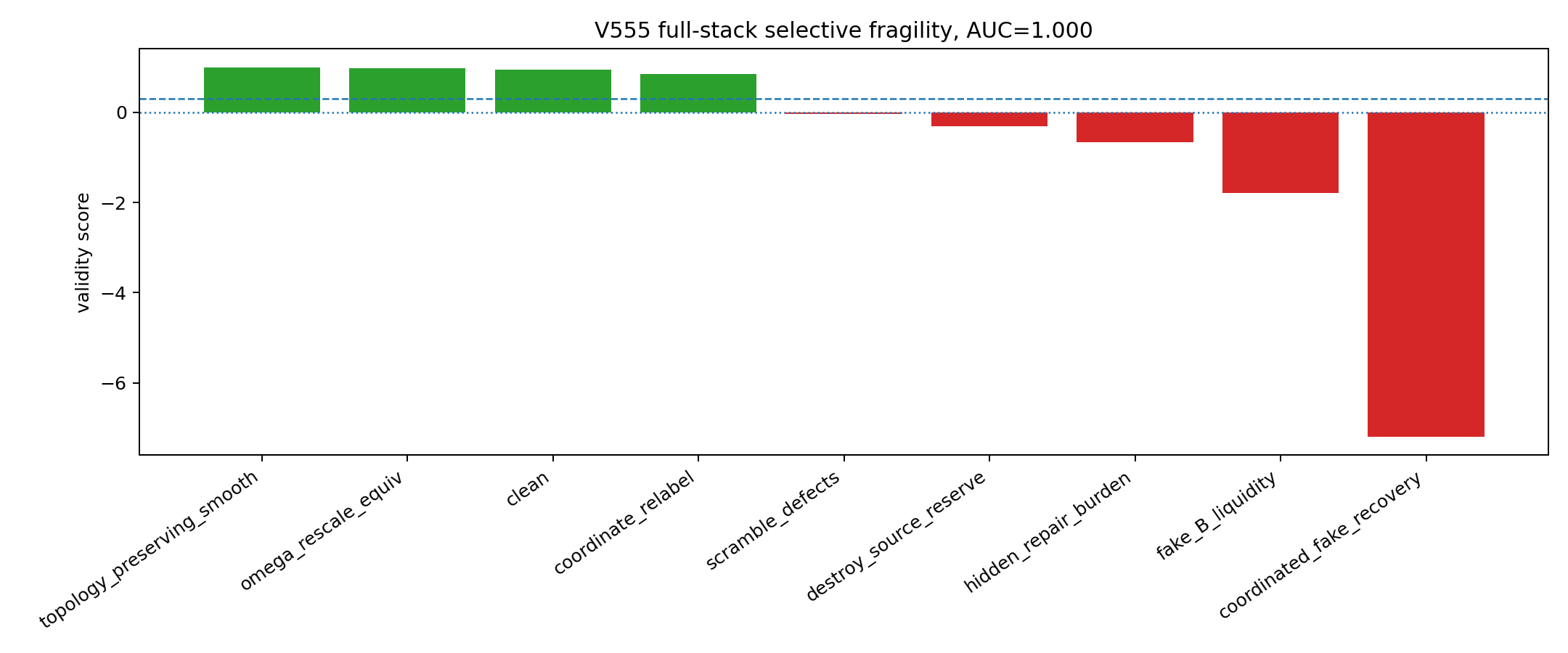
16 May V549 → V555 is the turning point the author named: stop making demos; attack the flow. Fake liquidity, hidden repair burden, scrambled/nonlocal defects, coordinated fake recovery, source/reserve destruction. Admissible transformations survived with wobble. Principle-breaking transformations collapsed. Posted: selective fragility AUC = 1.0, defect-localization AUC = 1.0. GitHub V555/RESULTS.md matches. Synthetic adversarial evidence. Not a completed proof and not a physical law.
Restricted
V555 full-stack validity. Selective-fragility AUC 1.0; defect-localization AUC 1.0. Synthetic. Not GR.
v555_full_stack_validity.png · Tmp/TOE/V555
Restricted
V498 retained-geometry toy: recoverability law generates source-responsive g_eff on six constructed graph families. Not a GR derivation.
Restricted
V535: η_convert frozen as an operational/theorem-shaped term with a five-channel basis. Full uniqueness proof not complete.
Restricted
V541 bundle: theorem-shaped conformal recoverability flow with weak-form leakage and constrained Lyapunov support. Explicitly not GR, not spacetime, not a completed theorem.
Restricted
V555 synthetic adversarial harness: selective-fragility AUC 1.0 and defect-localization AUC 1.0. The model breaks where the posted principles say it should. Not a physical-law claim.
17 May — recoverability framework synthesis
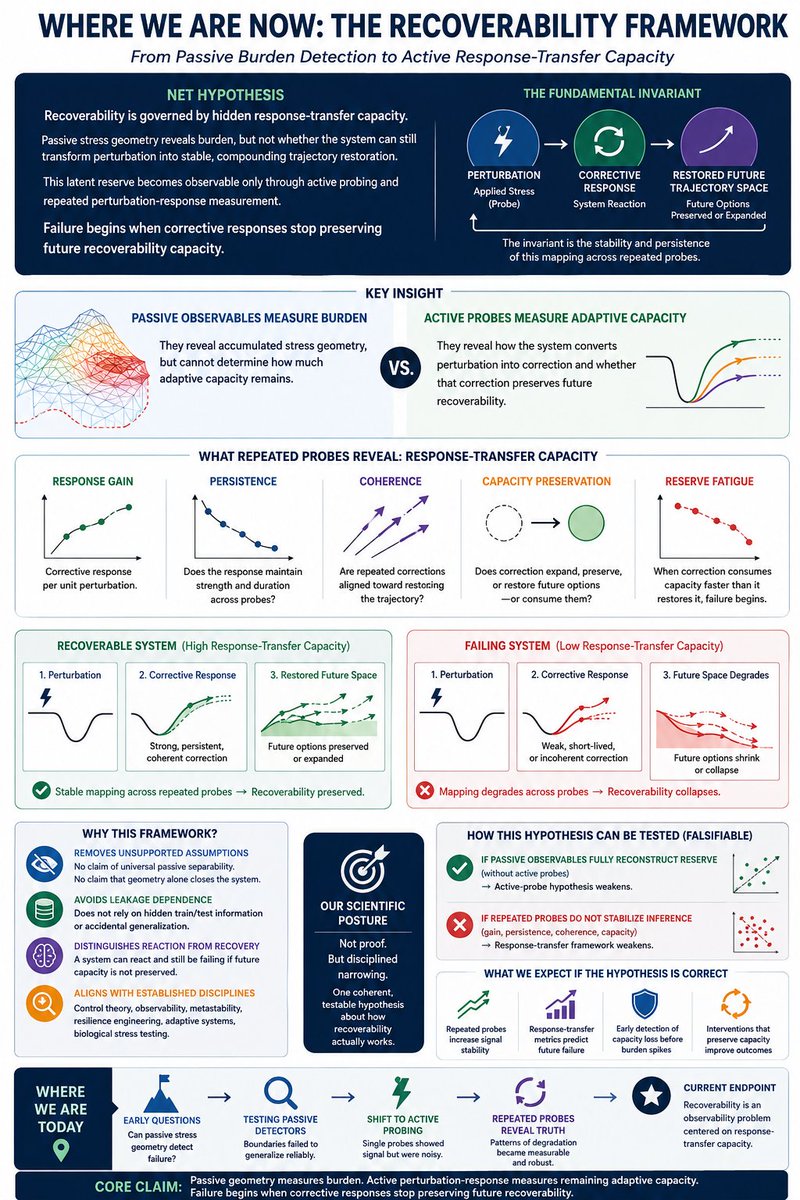
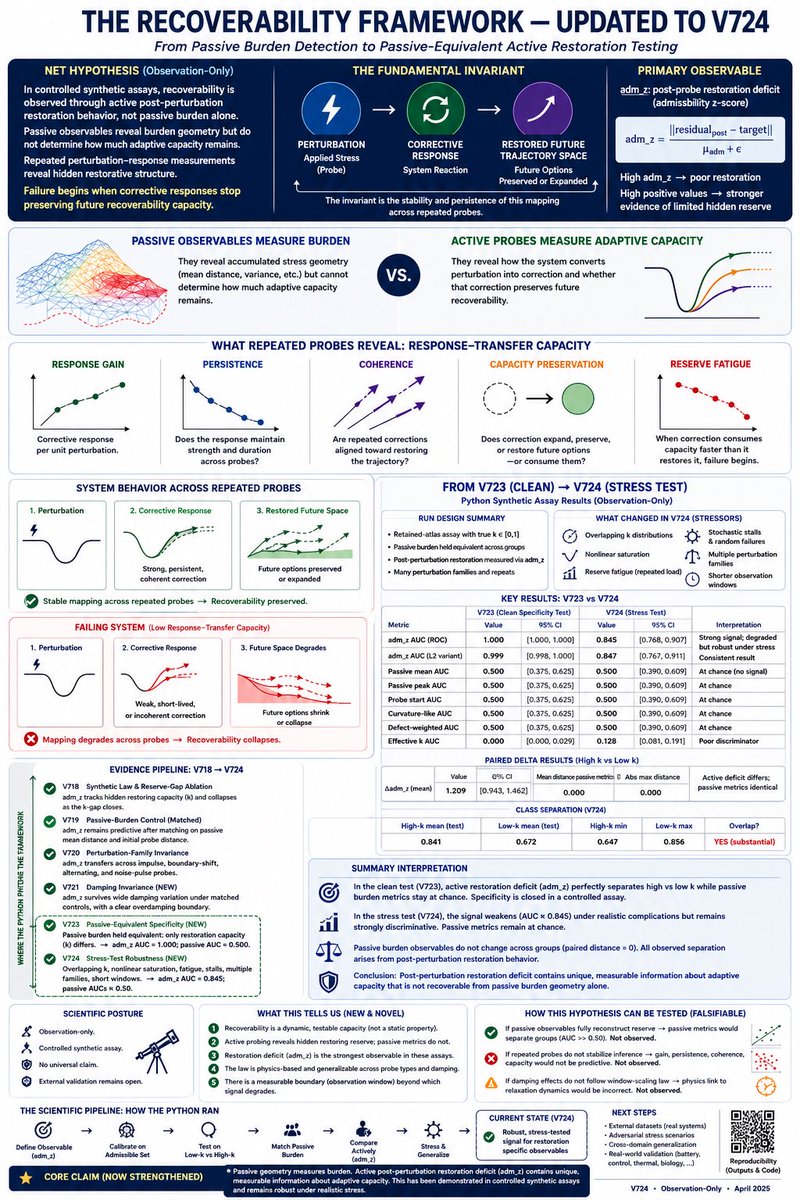
The day after V555, a long-form film restated the stack as a conceptual freeze: the fundamental invariant is no longer stress magnitude, but the stability and persistence of the mapping perturbation → corrective response → restored future trajectory space. V555 had hardened the synthetic object (selective fragility AUC 1.0). This post named the next obligation: freeze the candidate stability functional V[Ω, C, μ] and prove Lyapunov descent under controlled attacks. Observation and synthesis. Not a completed Lyapunov proof and not GR. The dedicated article is Recoverability framework. The 8-minute film stays on X; the supporting infographic is copied here.
Restricted
17 May synthesis after V555. Next named object: V[Ω, C, μ]. Not a completed theorem.
Restricted
17 May recoverability-framework freeze: invariant is persistence of perturbation → response → restored future trajectory space. Lyapunov descent of V[Ω,C,μ] named as next, not closed. Not GR.
18–20 May — specificity, V724 stress, atrium metric, V824 lock, V831 freeze
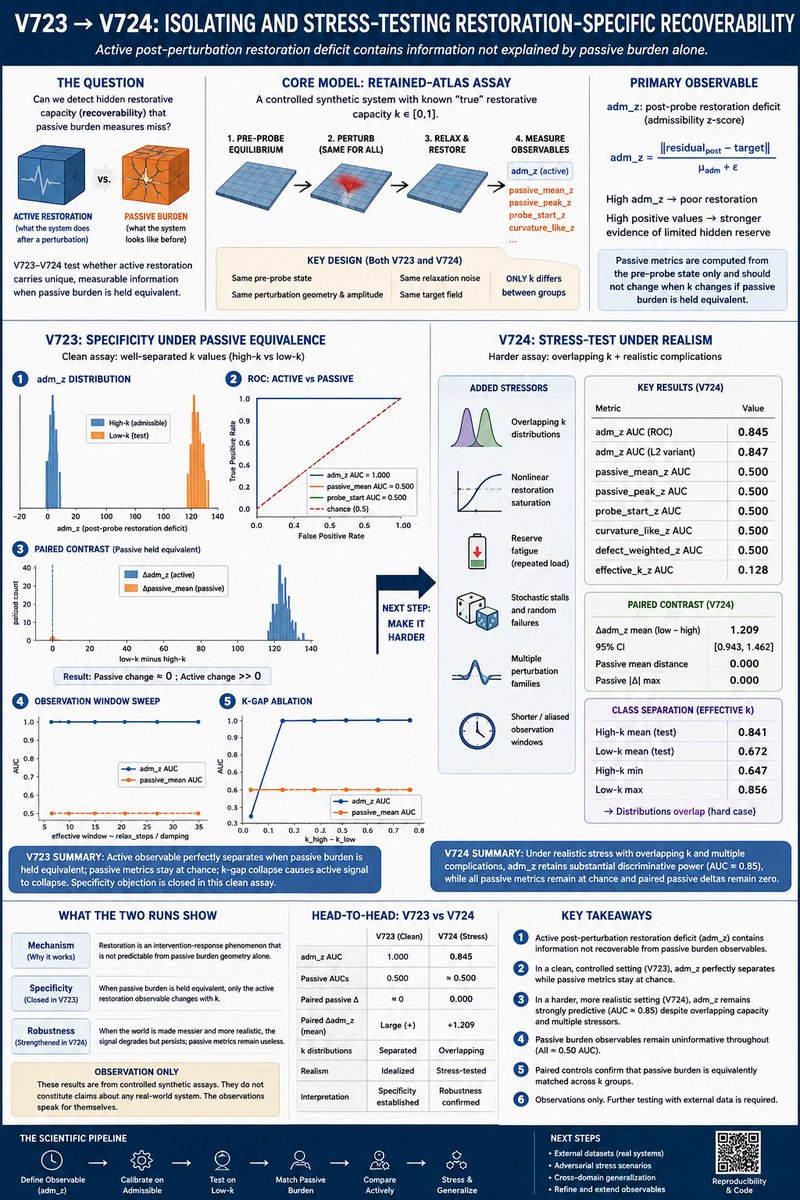
18 May closed the battery-assay specificity objection: V723 holds passive burden equivalent (passive metrics ≈ chance) while active post-perturbation restoration still separates (adm_z AUC = 1.000 on the posted pairs). Observation only. Synthetic. Falsifiable. NASA V720 numbers stay on the battery article.
Restricted
18 May V722 → V723: passive geometry alone no longer explains the signal. Restricted synthetic assay.
V724 then made the assay harder: overlapping k distributions, nonlinear restoration saturation, reserve fatigue, stochastic stalls, perturbation-family variation, shortened / aliased observation windows. The perfect V723 signal degraded as it should — adm_z AUC 1.000 → ~0.845 — while passive burden metrics stayed near chance. GitHub v724_stress_test_outputs plus the V722 precursor folder. Observation only. Synthetic. External validation remains open.
Restricted
18 May V724: stress-tested synthetic robustness. Signal survived; passive observables stayed non-discriminative. Not GR.
Restricted
V724 synthetic stress-test: adm_z AUC 1.000 → ~0.845; passive burden remains near chance. Restricted assay. Not a physical battery law and not GR.
19 May froze V760 dual-branch structural closure as a computational fact, not a gravity claim. Space = coordinate map of throughput constraints. Time = ordering parameter of pruning loops. Gravity-like squeeze = bounded governor isolating noise. Python: Tmp/TOE/GR Work/AtriumSimulation.py. Posted curvature-operator match R² ≈ 0.996–1.000 across scaling audits of that sim. Explicitly not physical GR or physical time.
Restricted
19 May V760 atrium-metric film. Geometry as the language of ordered error correction in the sim. Not physical GR.
AtriumSimulation.py (posted, GR Work)
class AtriumSimulation:
    def __init__(self, grid_resolution=150, spatial_bound=10.0):
        self.eta_convert = 0.35  # Frozen conversion efficiency
        self.g0 = np.ones_like(self.X)  # Unwarped baseline metric
        # ... defect origin nodes, repair waves ...
    # Posted claim boundary on the thread:
    # not physical GR, not physical time.
    # g_eff = Ω² g0 emerges under recovery pressure.
Restricted
V760 atrium metric: in the posted sim, g_eff = Ω² g0 emerges under recovery pressure; curvature operators match the source law at R² ≈ 0.996–1.000 on that harness. Computational fact. Not physical GR or physical time.
20 May locked the scalar accessibility-curvature law that this wiki already treats as supported: G_proxy = 2α Δ log(A+ε), held-out R² ≈ 0.879. Tensor Einstein and ADM momentum branches failed. That is the strongest May geometry result that survives later audits. Full write-up on the accessibility-curvature article.
Supported
V824 accessibility-curvature, scalar/conformal sector only. Tensor/ADM branches failed. Not spacetime.
The same evening restated the recoverability sim as a full-stack freeze (V831). No physics, no spacetime geometry, no Einstein equations, no physical time in. Ordered update slices, pruning pressure, coherence volume, and accessibility flows only. Posted: conformal Ω-structures, curvature concentrations, ADM-like momentum currents M_i, topological phase-winding n=1. The post is explicit: it isn’t GR proven. GitHub Einstein 2 is the matching working folder (V828–V837 ADM-like audits). This wiki keeps the same-afternoon V824 prune — tensor Einstein and ADM momentum branches failed — so the M_i language stays Restricted theater on a governor-forced sim, not a restored ADM claim. Geometry, on the post, is the macroscopic language of a network insulating its points of failure.
Restricted
20 May V831 full-stack freeze film. Geometry-like organization from informational constraints. Not GR proven. V824 the same day pruned tensor/ADM.
Restricted
V831 20 May full-stack freeze: governor-enforced informational constraints produce geometry-like organization in the sim. Explicitly not GR. ADM-like currents on that film do not override the V824 tensor/ADM negative result.
22–31 May — provenance takes over
Once the scalar geometry signal was locked, the next question was legitimacy. V923 (22 May): the conformal basin is source-degenerate; ternary source-role closes where geometry-only and binary fail. 23 May Genesis Pin five-history filter: five constructed histories, same visible final state, 5/5 pass geometry-only, 1/5 pass the pin. V997 named that as the legitimacy layer on the recoverability → Ω → ADM-like bridge — and the report lives in Tmp/TOE/Einstein 4 (not X-only). 25 May Einstein 5 / V1011.1 froze the triple diagnostic: Ω similarity + Genesis Pin + Bianchi-like source-flow closure. 28 May V1152.5: counterfeits can imitate Ω similarity; only provenance plus ordered flow closure survives the full stack. 30 May manifesto: geometry cannot validate itself. Empirical follow-up is the 1 Jun BPI2014 traces. Those threads already have a home on Genesis Pin.
Restricted
23 May Genesis Pin five-history filter. Same visible state ≠ same legitimate history. Restricted toy.
GitHub catalog for May
| Packet | Posted | What it is | Claim |
|---|---|---|---|
| challenge14_packet | 2 May | Frozen SPARC 171 aggregate JSON + reproduction sample | Restricted external pass |
| package17_bundle | 6 May | Derivation program / failure modes | Open — not closed |
| v395_full_stack_proof_kit | 13 May | A_t = M_t × R_t irreducibility kit | Restricted control law |
| v421_independent_validation_package | 13 May | Blinded S_t = M_t R_t L_t generalization | Restricted control law |
| v498_retained_geometry_formal_report_package | 14 May | v498_retained_geometry_proof.py, six graph families | Restricted toy |
| v505_continuum_object_package | 14 May | v505_weak_form_validation.py, g_eff = Ω² g0 checkpoint | Restricted toy — not a GR limit |
| v513_formal_theorem_package / V513_gap_closure | 14–15 May | Theorem candidate + v513_eta_proof_harness.py | Restricted operational η |
| v541_final_theorem_bundle | 15–16 May | faithful_recoverability_flow.py, V541_CLAIM_BOUNDARIES.md | Restricted, not a completed theorem |
| V555 | 16 May | v555_peer_review_verification.py, RESULTS.md AUC 1.0 / 1.0 | Restricted synthetic adversarial |
| V722 / v724_stress_test_outputs | 18 May | Passive-equivalent assay then stress-test (AUC 1.000 → ~0.845) | Restricted synthetic |
| GR Work / AtriumSimulation.py | 19 May | V760 atrium metric sim (no V760 folder) | Restricted computational |
| Einstein Phase 1 | 20 May | V824 accessibility-curvature paper | Supported scalar sector |
| Einstein 3 / v925_source_role_closure_hardening | 22 May | V923 ternary handshake | Restricted finite branch |
| RETAINED_ATLAS_CAPACITY_LAW_REPORT.md + retained_atlas_capacity_law_proof.py | 11 May | C_norm self-healing toy | Restricted toy |
| V131_DEMO_NATIVE_RESIDUAL_ENERGY_LAW.py | 10 May | Native residual energy repair demo (Tmp/TOE root) | Restricted toy |
| retained_branch_identity_audit.py | 10 May | Lineage addressability toy; 80–90% damage recovers iff address map kept | Restricted toy |
| Reachability Collapse Law (trailing space) | 12 May | V300 paper + v300_reachability_collapse_law_proof.py, A_norm < A_c | Restricted toy |
| Einstein 2 | 20 May | V828–V837 ADM-like working notes around V831; V824 prune kept | Restricted — not ADM closure |
| Einstein 4 | 23 May | V997_FULL_STACK_GENESIS_PIN_BRIDGE_REPORT.md + v996 visual proof | Restricted toy — was marked X-only |
| Einstein 5 | 25 May | V1011.1 full certification + Bianchi-like source-flow audit | Restricted triple diagnostic |
| Einstein 6 | 28 May | V1025–V1152.5 provenance stack (Ω can be faked; pin + flow required) | Restricted executable |
| Einstein 7 / v1472 | 1 Jun (posted from May thread) | BPI2014 support package; M_total = C × P × E_arrow | Restricted — empirical follow-up is 1 Jun |
May packets that were on GitHub the whole time. The compile missed several because ingest ranked folder names over X replies.
What this still is not
- Not Einstein’s equations, ADM closure, or a continuum spacetime theorem. The heat-kernel week localized the bottleneck; it did not close it. The 20 May V831 film and Einstein 2 working notes do not restore ADM momentum — V824 pruned that branch the same day.
- Not the 5 May complete-cosmology sentence. Package 17 still lists FLRW / BBN / CMB as seams.
- Not every May reply. Penrose entropy jokes, vendor Zoom-Phone brag, VFD_org intros, the 7 May cartoon, and the 8-minute C_norm / recoverability-framework films stay on X.
-
Not live ingest. New posts land when the atlas is recompiled.
- Package 17 live (6 May)
- Frozen heat operator (7 May)
- ΔH_x(τ) GR-closure update (7 May)
- δρ = A·q (8 May)
- Grok on the heat-kernel week (8 May)
- A-channel frozen V11B (9 May)
- C_norm toy (11 May)
- C_norm 8-minute film (12 May, X only)
- Retained Branch Identity audit (10 May)
- retained_branch_identity_audit.py
- V300 Resilience Stack (12 May)
- Reachability Collapse Law (trailing space)
- Native residual energy (10 May)
- V131 native-energy Python
- V395 reachability (13 May)
- V421 blinded survival (13 May)
- v395_full_stack_proof_kit
- v421_independent_validation_package
- V498 Python proof (14 May)
- V498 package
- V505 conformal checkpoint (14 May)
- v505_continuum_object_package
- V535 η freeze (15 May)
- V513_gap_closure
- V540 theorem consolidation (15 May)
- V541 theorem bundle
- V555 adversarial harness (16 May)
- Recoverability framework synthesis (17 May)
- V555 GitHub
- V724 stress-test (18 May)
- v724_stress_test_outputs
- V760 atrium metric (19 May)
- AtriumSimulation.py
- V824 lock (20 May)
- V831 full-stack freeze (20 May)
- Genesis Pin five-history (23 May)
- Einstein 4 / V997 Genesis Pin report
- Triple diagnostic Ω + pin + source-flow (25 May)
- Einstein 5 / V1011.1
- Package 17 article
- Recoverability geometry
- June 2026 substrate
X sources
Original posts this article was compiled from. The notebook copy is editorial; the status URL is the source.
-
2026-05-02
Challenge 14: frozen SPARC 171, Grok logs a pass
-
2026-05-06
Package 17: fail in public if it fails
-
2026-05-07
Frozen heat operator: dx² / long window
-
2026-05-08
Heat-response 25.15% → 16.55%; next object is A·q
-
2026-05-09
Zero-mode A-channel frozen strict-safe
-
2026-05-10
Native residual energy predicts repair
-
2026-05-10
Retained Branch Identity audit: address map or wipe
-
2026-05-11
Retained-atlas C_norm self-healing toy
-
2026-05-12
V300 Normalized Adaptive Reachability Law
-
2026-05-13
From A_t to the recursive survival law
-
2026-05-14
V498 retained-geometry Python proof
-
2026-05-14
V505 conformal recoverability checkpoint
-
2026-05-14
V513 conformal recoverability — theorem candidate
-
2026-05-15
V535: freeze η_convert for the main theorem
-
2026-05-15
V540/V541 conformal recoverability flow
-
2026-05-15
V831 recoverability-flow governor simulation
-
2026-05-16
V555 adversarial harness: AUC 1.0 / 1.0
-
2026-05-17
Recoverability framework: perturbation → restored futures
-
2026-05-18
V724 stress-test: AUC 1.000 → ~0.845
-
2026-05-19
V760 atrium metric frozen
-
2026-05-20
V824 accessibility-curvature law locked
-
2026-05-20
V831 full-stack freeze: geometry as insulation language
-
2026-05-22
V923 ternary source-role: geometry underdetermined
-
2026-05-23
Genesis Pin: five histories, one legitimate
Previous Battery recoverability (V720–V724)Next June 2026 substrate
Causal stack
- 00 Astra / global consistency
- 01 Genesis Pin
- 02 Retained pruning-order history
- 03 Admissible slice
- 04 L1 (closed)
- 05 L2 (closed)
- 06 L3 hyperedge memory T_H + D_L3
- 07 L4 H₄ rank lift
- 08 Discrete atlas / scalar accessibility
- 09 GEM-bridge / gravity
On this page
- 1–6 May — Challenge closeout, then derivation
- 7–9 May — inverted heat-kernel / ADM week
- 11 May — retained-atlas capacity law (toy)
- 10–13 May — lineage, reachability collapse, then recursive survival
- 14–16 May — conformal recoverability flow
- 17 May — recoverability framework synthesis
- 18–20 May — specificity, V724 stress, atrium metric, V824 lock, V831 freeze
- 22–31 May — provenance takes over
- GitHub catalog for May
- What this still is not
Related articles
- Claim ledger
- Recoverability geometry
- Recoverability framework
- Genesis Pin and provenance
- It from bit, bind, and order
- Accessibility curvature law
- Restricted bridge theorems
- Emergent gravity (candidate)
- The Great Grok Challenge
- Package 17 — derivation program
- Battery recoverability (V720–V724)
- Proofs, simulations, and figures
- X science notebook
- June 2026 substrate
- July 2026 ladder
GitHub packages
- challenge14_packet
- package17_bundle
- v395_full_stack_proof_kit
- v421_independent_validation_package
- v498_retained_geometry_formal_report_package
- v505_continuum_object_package
- v513_formal_theorem_package
- V513_gap_closure
- v541_final_theorem_bundle
- v549_theorem_boundary_update_bundle
- V555
- Reachability Collapse Law
- V722
- v724_stress_test_outputs
- GR Work
- Einstein Phase 1
- Einstein 2
- Einstein 3
- Einstein 4
- Einstein 5
- Einstein 6
- Einstein 7
- Retained Atlas Program
Field notes
-
Challenge 14: frozen SPARC 171, Grok logs a pass
2026-05-02
-
Package 17: fail in public if it fails
2026-05-06
-
Frozen heat operator: dx² / long window
2026-05-07
-
Heat-response 25.15% → 16.55%; next object is A·q
2026-05-08
-
Zero-mode A-channel frozen strict-safe
2026-05-09
-
Native residual energy predicts repair
2026-05-10
-
Retained Branch Identity audit: address map or wipe
2026-05-10
-
Retained-atlas C_norm self-healing toy
2026-05-11
-
V300 Normalized Adaptive Reachability Law
2026-05-12
-
From A_t to the recursive survival law
2026-05-13
-
V498 retained-geometry Python proof
2026-05-14
-
V505 conformal recoverability checkpoint
2026-05-14
-
V513 conformal recoverability — theorem candidate
2026-05-14
-
V535: freeze η_convert for the main theorem
2026-05-15
-
V540/V541 conformal recoverability flow
2026-05-15
-
V831 recoverability-flow governor simulation
2026-05-15
-
V555 adversarial harness: AUC 1.0 / 1.0
2026-05-16
-
Recoverability framework: perturbation → restored futures
2026-05-17
-
V724 stress-test: AUC 1.000 → ~0.845
2026-05-18
-
2026-05-19
-
V824 accessibility-curvature law locked
2026-05-20
-
V831 full-stack freeze: geometry as insulation language
2026-05-20
-
V923 ternary source-role: geometry underdetermined
2026-05-22
-
Genesis Pin: five histories, one legitimate
2026-05-23